
Straight Answers, Citations Included.
Every answer below follows the same rule as our reports: name the standard, give the number, skip the scare stories. It's how an inspector would explain it at your kitchen table.
General
13 questionsDo I actually need my air ducts cleaned?
Maybe not — and we'll be the ones to tell you. EPA guidance says duct cleaning is warranted in three situations: visible mold, vermin in the ducts, or significant dust and debris buildup. Not on a calendar, not automatically every few years. Our $99 camera inspection checks your system against those conditions and gives you a straight verdict with photos. A meaningful share of inspections end with 'not yet, re-check in a couple of years' — and that answer costs you $99, not $600.
Will duct cleaning help my allergies or asthma?
Honestly: there is no good evidence that it does, and the EPA states plainly that duct cleaning has never been shown to prevent health problems. It genuinely helps when your system meets one of the EPA's three conditions — visible mold growth, vermin, or debris actually being released into your rooms — and a camera inspection tells you which. For a household with asthma or heavy seasonal allergies, the changes that reliably move indoor air are a filter matched to what your blower can pull, a return path that isn't starved, and sealing ducts that are pulling attic air into the house. We would rather point you at those than sell you a cleaning you don't need.
We have a new baby — should we get the ducts cleaned?
Only if something has actually loaded them, and the usual culprit is renovation. Drywall dust and jobsite debris land on the return side where a filter never reaches them, so a nursery remodel with the system running is a real case and the before-and-after footage shows it. If nothing has changed about the house, start with the $99 camera inspection — it often ends the conversation. And one hard rule regardless: no ozone-generating air cleaner near an infant. The EPA is clear those aren't effective at concentrations that are safe to breathe.
How much does air duct cleaning cost?
A full-system source-removal cleaning starts at $349, targeted supply-and-return work at $199, and a camera inspection at $99. Those are honest starting points, not bait: your exact quote is confirmed after we look at the system on camera and before any work begins, and it doesn't change mid-job. Add-ons like sanitizing ($149) or a UV light ($399) are offered only when the footage shows a real indication — our technicians don't earn commissions.
How long does a full-system cleaning take?
Three to five hours for a typical single-system home. The honest variables are the number of runs, attic access, duct type, and how much debris the system is carrying — a two-system two-story takes longer than a compact ranch. We'd rather quote you a real window than promise a ninety-minute miracle, because whole-home source removal physically cannot be done in ninety minutes. You'll get a specific time estimate with your quote, and the system is back on the moment we finish.
How often should air ducts be cleaned?
There's no honest fixed schedule, and we won't invent one. Ducts need cleaning when their condition says so — after a renovation, a pest issue, a moisture event, or gradual buildup that's now visible on camera. Some systems go a decade staying respectable; others load up in three years because of construction next door or a heavy-shedding pet. The economical habit is an inexpensive camera inspection every few years: it either buys you peace of mind or catches the problem while it's a targeted cleaning instead of a full one.
Why do some companies advertise whole-house duct cleaning for $99?
Because it works as advertising. Genuine source removal takes hours of labor and serious equipment — a negative-air machine, agitation tooling, containment — and that has a real cost. A $99 whole-house price generally funds a quick vacuum at the registers plus a high-pressure pitch for add-ons once the crew is inside. We're not the cheapest ad in the mailer; we're the published-price company that shows you camera evidence before and after. If a deal tempts you, book our $99 inspection first and make them beat the footage.
Is the cleaning messy or disruptive?
It shouldn't be, and with the right method it isn't. The whole point of negative pressure is containment: registers are sealed, the system is placed under vacuum, and dislodged debris travels into a HEPA-filtered collector rather than your rooms. Floors get drop cloths, corners get guards, and crews wear shoe covers. You can stay home and carry on — the HVAC is off during the work, which on a summer afternoon is the only inconvenience worth mentioning. We leave the house as we found it, minus what was in the ducts.
What happens if you find mold in my ducts?
First, you see it on camera — no mystery, no pressure. Then the honest split: microbial growth on hard sheet-metal surfaces can be physically cleaned and, where indicated, treated with an EPA-registered product. But EPA is clear that moldy porous materials like duct-board liner and insulation can't be effectively cleaned — replacement, which is HVAC-contractor work, is the right fix, and we'll tell you so rather than sell a cleaning that won't hold. Either way, the moisture source has to be addressed, or the growth returns regardless of who cleaned what.
Do you use chemicals in the ducts?
Not by default. The cleaning itself is mechanical — brushes, air whips, and vacuum collection — with no chemicals involved. The only product we ever apply is an optional antimicrobial treatment, and it comes with three hard rules: the product must be EPA-registered specifically for HVAC use, it's applied exactly as the label directs, and it's only offered when there's a documented indication like microbial staining or animal-intrusion cleanup. You approve it beforehand, and you get the product name and label information for your records.
Can dirty ducts cause smells in the house?
Yes, and the smell usually names its own source. Musty points to moisture — condensation or past leaks feeding microbial growth. An animal odor points to intrusion, present or past. An attic-like or dusty note often means a run has pulled loose and is drawing unconditioned air into the system, which is remarkably common in Texas attics. Our $99 odor investigation traces the smell methodically and shows you photos of what it finds — including, sometimes, that the source isn't your ducts at all. That honesty is the point of the service.
What areas do you serve?
Dallas–Fort Worth is home turf — Dallas, Fort Worth, Arlington, Plano, Frisco, McKinney, and the communities around them. From there we cover twenty-two metros across Texas, including Austin and its corridor from Cedar Park to Georgetown, San Antonio with Boerne, Schertz, and New Braunfels, and greater Houston from Katy and Sugar Land to Pearland and The Woodlands. Same crews' standards, same published pricing, same camera-first process everywhere. If you're between our cities, call anyway — routes flex more than maps suggest.
What proof do I get that the work was actually done?
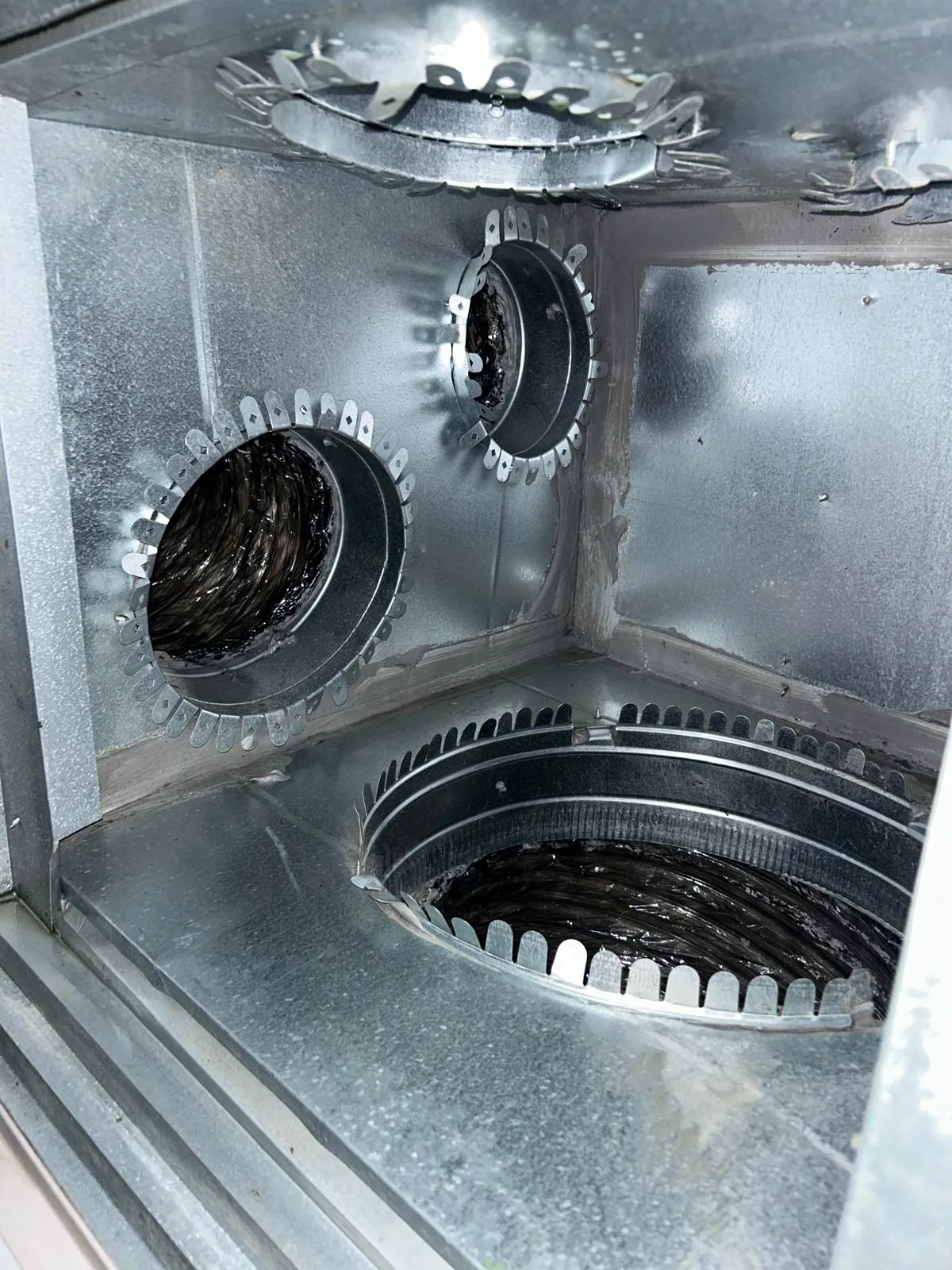
Photos of the inside of your own ductwork — before we start and after we finish — plus a written record of exactly which runs were cleaned and what we found along the way. Duct work is invisible from the hallway, which is precisely why this industry has a trust problem: you can't glance at a duct the way you can a mowed lawn. Evidence closes that gap. If any company, ours included, can't show you the inside of your ducts after charging to clean them, ask why.
Last thing
Get it inspected. Get it in writing.
A $99 camera inspection is the cheapest way to find out whether you need us at all — and a real share of them end with “not yet”. Either way you keep the footage.
- Photos either way
- Written quote first
- Licensed & insured
Open Mon–Sun 7:00 AM – 12:00 AM · a person answers