
Education

Air Duct Glossary

Every term we use on an inspection report, explained without jargon. It's the same vocabulary your HVAC contractor and home inspector will use — so you can hold all three of us to it.

MERV

The standardised scale for how efficiently a filter captures particles.

Minimum Efficiency Reporting Value, defined by ASHRAE Standard 52.2. Higher numbers capture smaller particles and more of them, and ratings are comparable between manufacturers. The number alone is not the whole decision: efficiency comes with airflow resistance, and a filter your blower cannot pull through reduces system performance rather than improving your air.

Open full page
Pressure Drop

The airflow resistance a filter or fitting adds to the system.

The loss in static pressure across a component. For filters it rises with efficiency and falls with surface area, which is why a deep media cabinet can run a higher MERV at lower resistance than a one-inch filter. It also rises steeply as a filter loads — a filter left in too long can restrict airflow more than a new filter two grades higher would.

Open full page

Static Pressure

The pressure the blower works against — the measurement that says what filter a system can take.

The resistance the air handler must overcome to move air through the ducts, coil and filter. Measuring it tells you how much headroom exists before an upgrade starts hurting performance, which is why it should be checked before a filtration change rather than after. High static pressure shows up as poor room airflow, long run times and, in cooling, a coil that can approach freezing.

Open full page

NADCA ACR Standard

The industry standard defining what a legitimate duct cleaning actually is.

The Assessment, Cleaning and Restoration standard published by the National Air Duct Cleaners Association. Its core requirement is source removal — putting the system under negative pressure and mechanically agitating every run so debris is extracted rather than redistributed. It requires proper access openings and their correct resealing. A service that vacuums registers is not cleaning to this standard.

Open full page

Source Removal

Extracting debris from the system rather than dislodging it into the airstream.

The defining method of a real duct cleaning: the system is placed under negative pressure so that everything loosened is drawn out of the building, and each run is agitated mechanically so material is actually released. Cleaning without negative pressure moves contamination around the system instead of removing it.

Open full page

Plenum

The main air chamber directly at the air handler where supply or return trunks connect.

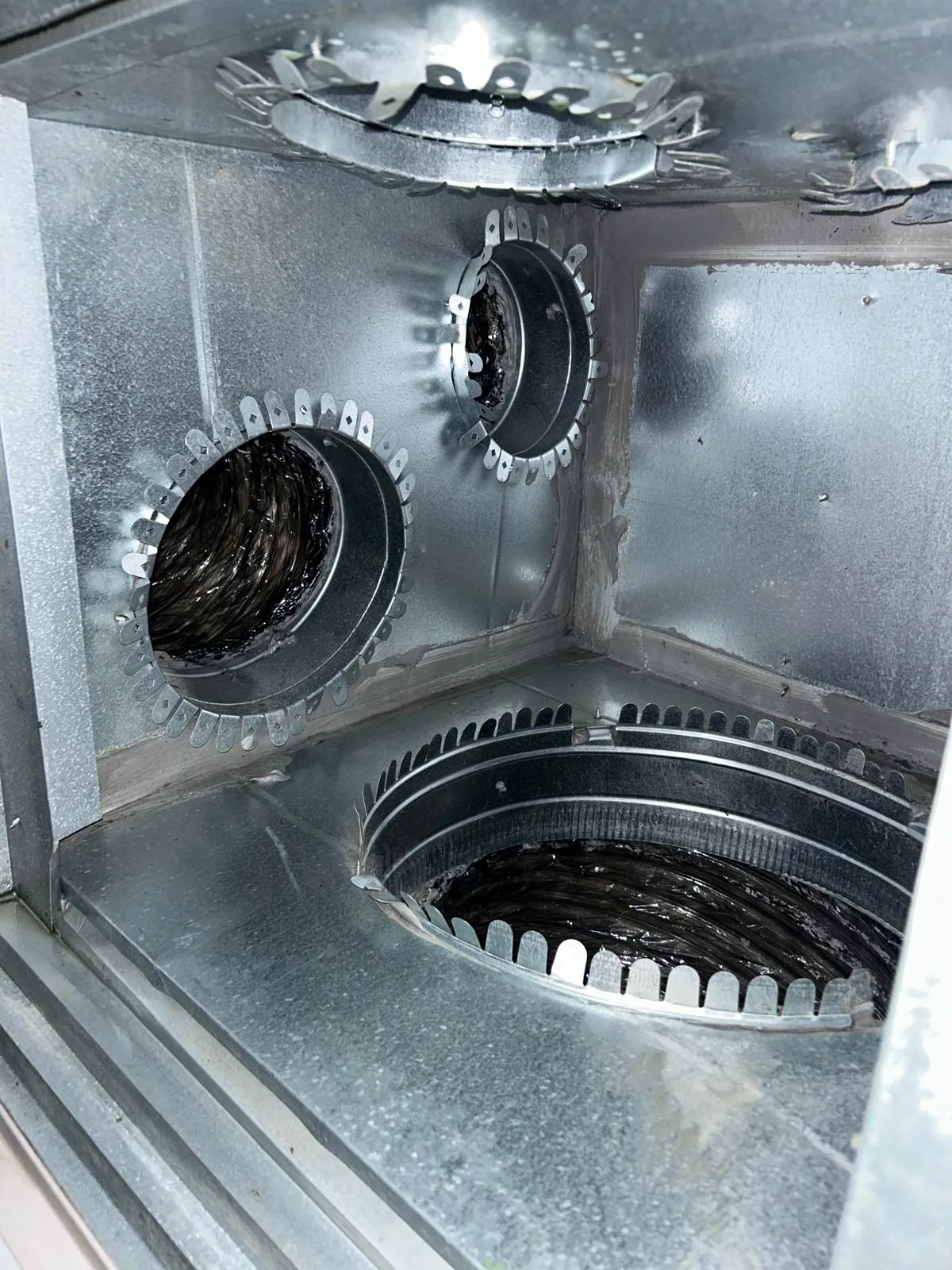
The box immediately at the equipment from which the trunk ducts branch. Supply and return plenums are the highest-velocity, highest-consequence part of the system, and leakage at plenum takeoffs is among the most expensive kinds — it is conditioned air lost right at the source. Plenums are also where access openings are usually cut for cleaning.

Open full page

Boot

The fitting where a duct run connects to a ceiling, wall or floor opening.

The transition piece between the branch duct and the register or grille opening. Boots are the most consistently unsealed joint in residential construction and they sit directly against an attic or crawlspace, which makes them the worst possible place to leak — conditioned air out, unconditioned dusty air in, at exactly the point you feel it.

Open full page

Duct Leakage

Air escaping from or being drawn into the duct system outside the conditioned space.

Loss and infiltration through unsealed joints, seams and boots. It costs twice: the conditioned air you paid for is lost, and replacement air is pulled from attics, crawlspaces and wall cavities — bringing their dust, temperature and humidity indoors. It is the reason a system that keeps getting dirty often needs sealing rather than another cleaning.

Open full page

Aerosol Duct Sealing

Sealant delivered as an aerosol inside the ducts, closing leaks that cannot be reached.

A sealing method in which the system is pressurised and an aerosolised sealant is introduced, depositing at leak edges until they close. It reaches leaks behind drywall and buried in insulation that no one can physically access. It is measured — the system is pressure-tested before and after — so the result is a number rather than an assurance.

Open full page

Mastic

Brush-applied sealant, usually with reinforcing mesh, for accessible duct joints.

The durable, lower-cost sealing method for joints that can physically be reached. Applied with mesh at seams, boots and plenum connections, and used with closure systems listed for duct sealing. Its only real limitation is access — it cannot seal a joint inside a wall, so on systems with concealed leakage it is not a complete answer on its own.

Open full page

Flexible Duct

Insulated flexible branch duct — legitimate installed correctly, a liability installed typically.

Wire-helix duct with an insulating jacket, widely used for branch runs. Installed properly it is pulled taut, supported at intervals and turned with generous radii. Installed the way it usually is — draped over joists, sagging between supports, compressed at bends — it loses a large fraction of the airflow to whatever is downstream. Most single-room comfort complaints end here.

Open full page

Rigid Sheet-Metal Duct

Fabricated metal trunk and branch duct built to industry construction standards.

Metal ductwork fabricated and assembled to the sheet-metal industry's construction standards, then sealed and insulated. It costs more than flexible duct and lasts the life of the building, which is why main trunks and plenum takeoffs should be metal even where branches are flex.

Open full page

Balancing Damper

An adjustable damper in a branch run that apportions airflow between rooms.

A damper installed in the branch duct so airflow can be deliberately divided rather than being decided by whichever run has the least resistance. It is the most common real fix for the upstairs-is-always-hot complaint and is usually far cheaper than the equipment change homeowners assume they need. It only works on a duct system that is otherwise sound — balancing a leaking system just relocates the problem.

Open full page

Return Air

The path air takes back to the air handler — the half of the system most often undersized.

The ducting and grilles that bring air back to the equipment. If the return path is inadequate for the system's tonnage, the result is rooms that never balance, doors that thump when the system starts, and a blower permanently working harder than designed. A useful test: if closing a room's door makes it worse, that room has a return-path problem, not a supply problem.

Open full page

Evaporator Coil

The wet, cold heat-exchange surface where biological growth genuinely establishes.

The indoor coil that absorbs heat from the air. It condenses moisture continuously through the cooling season, which makes it the one place in the system where growth reliably takes hold, and a fouled coil raises pressure drop and cuts capacity. Many complaints blamed on ducts are actually a dirty coil or blower wheel.

Open full page

Blower Wheel

The fan that moves all the air — and loses noticeable output when it fouls.

The squirrel-cage fan in the air handler. Dust cakes between the blades and progressively reduces the air it can move, which shows up as poor airflow throughout the house. It is a common cause of an airflow problem that survives a duct cleaning, and it is not reached by cleaning the ducts alone.

Open full page

UV-C Coil Treatment

Ultraviolet light aimed at the coil to suppress growth on its surface.

Germicidal ultraviolet directed at the evaporator coil, where continuous exposure and a permanently wet surface make the effect real and defensible. Claims of sterilising the air passing through the duct do not hold up against contact time — air is in front of the lamp for a fraction of a second. Lamp output declines before the lamp visibly fails, so replacement is scheduled rather than reactive.

Open full page

Zero-Ozone Validation

The separate standard confirming an air-treatment device does not emit ozone.

Some air-cleaning technologies produce ozone as a by-product, and ozone is a respiratory irritant — which is why a distinct zero-ozone validation exists for these devices. It is the first question to ask about any in-duct treatment product beyond filtration, and a device without it does not belong in a home's air stream.

Open full page

Deep Media Cabinet

A four- or five-inch filter housing that holds far more filter area than a one-inch slot.

A cabinet at the return holding a deep pleated media filter. The extra surface area means higher efficiency at lower resistance than a one-inch filter can achieve, and it extends the change interval to once or twice a year. Its only real constraint is physical space at the return, which is not always available in a tight closet or attic platform.

Open full page

Filter Bypass

Air travelling around an unsealed filter instead of through it.

What happens when a filter sits loose in an oversized slot. Air takes the easy path, so a substantial fraction is never filtered at all and its dust goes straight to the coil. The visual tell is a filter that has loaded in patches rather than uniformly. Sealing the slot often does more measurable good than raising the filter's MERV rating.

Open full page

Duct Insulation

Insulation on duct crossing unconditioned space — a capacity and condensation issue.

Insulating jacket on duct running through an attic or crawlspace. Where it is thin or has fallen away, cooling capacity is lost on the way to the room, and the duct surface can drop below the dew point and sweat — which soaks the insulation and keeps it wet. In a North Texas attic both effects are significant through the summer.

Open full page

Negative Pressure

Putting the duct system under suction so loosened debris leaves the building.

The condition established by the collection equipment during a proper cleaning, so that everything dislodged is drawn out rather than redistributed. It is what separates source removal from moving contamination around, and it is the reason a legitimate cleaning requires access openings and equipment rather than a shop vacuum.

Open full page

Access Port

A sealed, closable opening cut into the duct for cleaning and inspection.

An opening made in a trunk or plenum so equipment can reach inside, fitted with a cover that restores the system's integrity afterwards. Cleaning to the industry standard is not possible without them. A company that cleans without cutting access has not cleaned the parts of the system that hold the debris.

Open full page

Mold Remediation Boundary

The line between duct cleaning and licensed mold remediation.

Where visible mold growth is found, the response is governed by the moisture source and, in Texas, by licensing — remediation of mold in ducts, plenums or HVAC components is licensed work and is not the same thing as duct sanitising. The correct sequence is always to identify and correct the moisture source first; treating growth without fixing why it is wet produces a temporary result.

Open full page

Term you don’t see here?

This is a starter set, not a finished dictionary. Send us the word you got stuck on and we’ll add it.

Submit a term

Last thing

Get it inspected. Get it in writing.

A $99 camera inspection is the cheapest way to find out whether you need us at all — and a real share of them end with “not yet”. Either way you keep the footage.

  • Photos either way
  • Written quote first
  • Licensed & insured

Open Mon–Sun 7:00 AM – 12:00 AM · a person answers

Or leave three fields

3 fields

We call you back, tell you what your system likely needs, and book only if it's worth booking.

Rather talk now? (469) 287-0686