
Duct Damage, Documented Well Enough To Be Evaluated
Photographed findings tied to locations, a measured extent with its boundary marked, and a line-item scope an adjuster can price. What we produce is evidence. What happens with the carrier is your side of it.
Call before demolition and before the system runs again. Extent that has already been disturbed cannot be proven.
We produce evidence. We do not produce outcomes.
Claim work attracts promises that a duct contractor has no ability to keep. Here is the boundary, before you spend a minute on the rest of the page.
- Negotiating with your carrier is not something we do. Public adjusting is a licensed role and we do not hold it, so we cannot represent you in a claim. Our document goes to whoever you send it to, and the conversation with the carrier is yours or your adjuster's.
- We cannot tell you whether something is covered, and we will not guess. What your policy says and how your carrier reads it decide that question, and a duct contractor's report has no standing in it.
- We do not promise a claim outcome, a payout, or that a supplement gets approved. A contractor promising any of those is selling you something outside their control.
- We do not remediate mold. We inspect, document, and sample; where the affected area exceeds the regulated threshold, remediation is performed by a licensed remediator and we hand you the documentation and a referral.
- We will not attribute a condition to the loss if the photographs do not support it. That holds even when the client would prefer otherwise, because a document that stretches once is worth nothing the next time.
The duct portion is the part that gets left out.
A forced-air system moves whatever the loss produced into rooms the loss never touched. It also hides that fact behind a grille, which is why the ductwork routinely shows up as a supplement months later instead of in the original scope.
Fire and smoke
Smoke travels on the return side and deposits soot on duct interiors, the coil face, and the blower wheel in rooms the fire never reached. Odor complaints months later usually trace back to exactly this. We document deposit on the interior surfaces run by run, because a smoke claim scoped from what the walls look like misses the part of the building that redistributes it.
Water intrusion
A roof opening, a supply line, or a backed-up condensate drain puts water into ductwork that has no way to dry. Fibrous liner and insulated flex hold it. We photograph saturation, staining, and any collapse, and we record where the water entered relative to each run so extent is a documented boundary rather than an estimate.
Animal and vermin intrusion
Rodents in an attic find open boots and torn flex, and what they leave behind is a contamination question with an EPA-recognized reason to clean. We photograph nesting, droppings, and the entry damage, then document which runs are affected and which are not, since claims get argued over exactly that line.
Storm openings
Wind or impact opens a roof or soffit and the attic becomes the outdoors for a while. Blown-in insulation, roofing granules, and debris get pulled into open or damaged runs. The duct portion of this loss is routinely left out of the original scope and surfaces later as a supplement nobody has evidence for.
Evidence first. Everything else after.
Document before anyone cleans up
The single most useful thing you can do is call before demolition, before a cleaning crew touches the registers, and before the system is run again. Once debris is disturbed the extent is unprovable, and an adjuster is entitled to say so. If cleanup has already started, tell us what was moved and we record that too rather than pretending the scene is untouched.
Photograph with a location reference
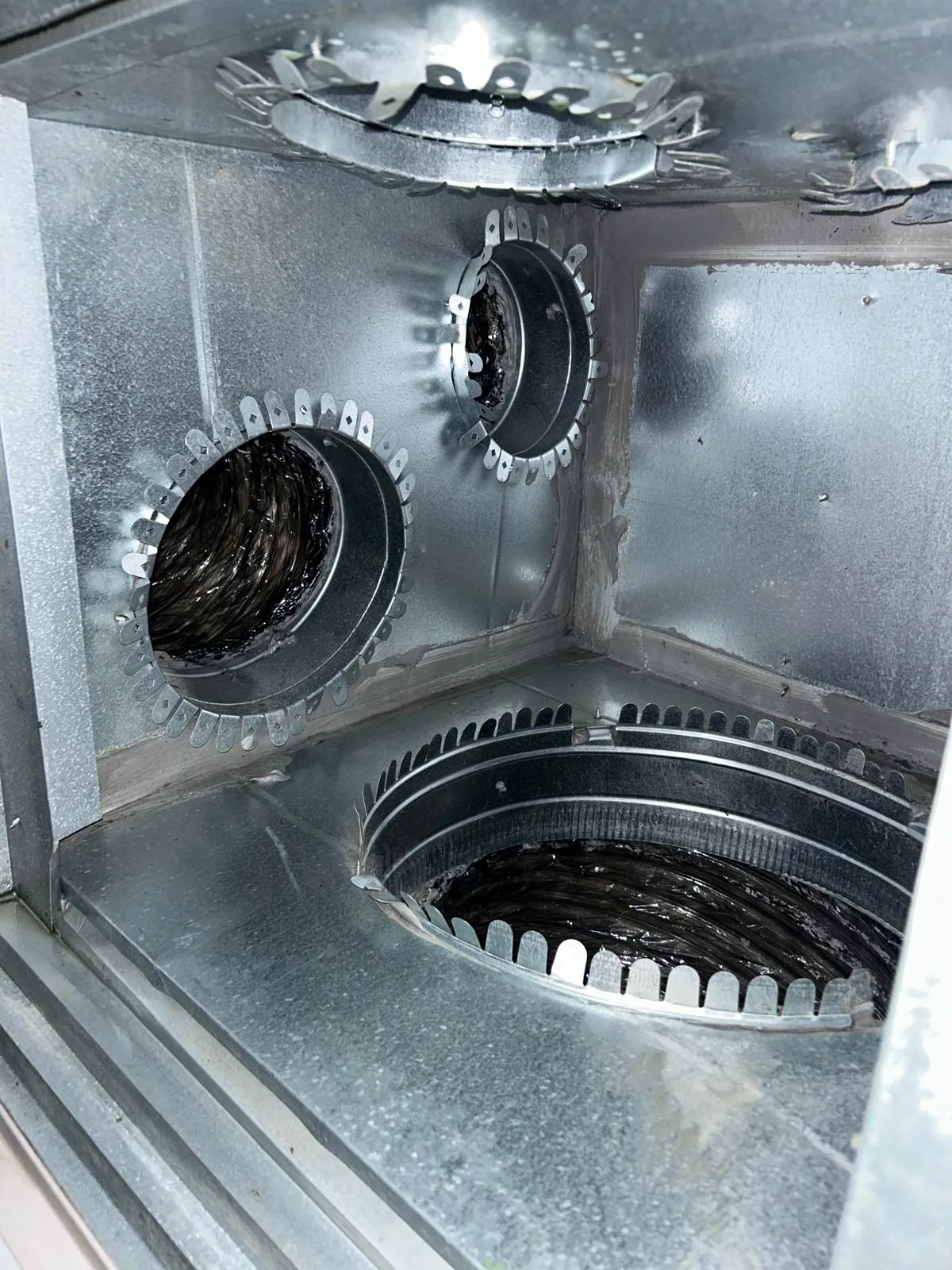
Borescope images from inside each accessible run, plus wide shots that place the run in the building. A photograph of soot with nothing around it proves nothing about where it was. Every image is dated, and each one is tied to a room and a register position so the file can be followed by someone who was never on site.
Measure the extent, and mark its edge
Which runs are affected, how far the deposit or saturation carries, and where it stops. The runs we find unaffected are recorded as unaffected. That boundary is what separates a scope an adjuster can approve from a number that reads as a guess.
Separate loss-related from pre-existing
Systems have histories. Old dust load, a coil that has been dirty for years, or a run that was crushed during construction are not storm damage, and we write them as pre-existing when that is what the evidence shows. This is the part that occasionally disappoints a client, and it is also the reason our documents hold up.
Write it as a scope, not a paragraph
Line items with quantities: runs cleaned, linear feet of flex replaced, plenum work, coil and blower cleaning, register count. Each line references the photograph that supports it. An adjuster can price a document like that. Nobody can price a narrative.
Six parts, and one of them is the list of what is fine.
Dated photo set with a location index
Interior and contextual images, numbered, each tied to a room and register so the sequence can be followed without a site visit.
Written condition findings
What was observed in each accessible run, both plenums, and the coil compartment, stated as observation rather than conclusion.
Extent map
Affected runs, unaffected runs, and where the boundary sits. The unaffected list is included deliberately — it is what makes the affected list credible.
Line-item scope with quantities
Counted and measured work, each line cross-referenced to a photograph, in a form an adjuster can price against their own schedule.
Pre-existing condition note
Anything present that the loss did not cause, stated separately so nobody discovers it later and questions the whole document.
Laboratory results where sampling applies
Where suspected growth is involved, samples go to an independent laboratory and the report arrives with a plain-language summary of what it does and does not show.
The visit has a price. The restoration does not, yet.
The documentation visit is a defined piece of work and it is priced like one. The restoration scope that comes out of it is not, because until the runs have been opened and photographed nobody knows how much of the system the loss actually reached. Any figure quoted before that visit would be invented, and an invented figure is the fastest way to lose an adjuster.
Prices shown are starting estimates and may change with the condition, access, and scope we find on site. Only a written quote from an on-site visit is a price we commit to.
Where laboratory sampling is warranted, that is a separate service with its own published rate on the pricing page, plus whatever the independent laboratory charges, passed through without a markup from us.
Nearby on this site
Sampling, laboratory results, and a referral to a licensed remediator. We never remediate.
Camera inspectionThe borescope pass the documentation visit is built on.
Repair and replacementWhat replacing a saturated or collapsed run actually involves.
Emergency responseWater intrusion, vermin, or a smell that arrived overnight.
Tell us what happened, when, and whether anyone has cleaned up yet.
That last answer changes the urgency more than anything else. If a cleanup crew is booked for tomorrow, say so on the call and we will work to get in front of them.
Request a compliance quote
Single-site, multifamily, or national portfolio — tell us the system and the sites.
Claim documentation — FAQ
Can you handle the carrier on our behalf?
No. We produce the evidence and the scope; you or your adjuster handle the carrier. We are not a public adjuster and holding ourselves out as one would be a licensing problem, not just a stretch. What we will do is answer factual questions about our own findings if an adjuster calls, and go back out with them if they want to see a run for themselves.
Is duct cleaning covered after a fire or water loss?
That depends on your policy and your carrier, and we genuinely cannot answer it. What we can do is make sure the duct portion of the loss is documented well enough to be evaluated instead of overlooked, which is a different thing and the only part we control. Ask your adjuster the coverage question directly.
The restoration company already cleaned the house. Is it too late?
Not necessarily, but it is harder. Interior duct surfaces are often the last thing a general cleanup touches, so evidence frequently survives inside the runs even after the rooms are done. We will look, document honestly what condition the scene is in by the time we arrive, and note what was disturbed before us. That note matters, because it is the difference between a document an adjuster trusts and one they discount.
Following a loss, how quickly does someone come out?
We treat documentation visits as time-sensitive and prioritize them, and we will give you a real time on the phone rather than a comfortable one. If cleanup crews are already scheduled, tell us when they start — that date drives our scheduling more than anything else you can say.
Can you write a report that supports what our contractor already scoped?
We will write what we find. If it happens to support the existing scope, that is what the document will say; if it does not, that is also what it will say. A report written to match a number instead of a condition is worthless the first time somebody compares it to a photograph, and it would put every other file we have written in doubt.
Do you handle commercial losses as well as houses?
Yes, and the documentation discipline is the same. What changes is the scale of the system, after-hours access, and the fact that a commercial file usually has to satisfy a property manager, an owner, and a carrier at once. That gets scoped from a walkthrough, like any commercial job.
There is a smell after the loss but the ducts look fine. What then?
Then we say the ducts look fine, in writing, and keep looking at the parts of the system that are not the runs. Post-loss odor frequently sits at the coil, in the condensate pan, or in a wet insulation cavity next to a return rather than in the ductwork itself. Naming the actual source is more useful to a claim than cleaning the wrong component and having the smell come back.
Last thing
Get it inspected. Get it in writing.
A $99 camera inspection is the cheapest way to find out whether you need us at all — and a real share of them end with “not yet”. Either way you keep the footage.
- Photos either way
- Written quote first
- Licensed & insured
Open Mon–Sun 7:00 AM – 12:00 AM · a person answers