
Full-System Air Duct Cleaning in Cibolo
Whole-home source-removal cleaning of every supply and return run.
01Cibolo — the housing record
What Cibolo actually has behind its walls.
Before anyone quotes a duct job here, this is the stock they are quoting against. It is public Census data, and it is different in every city we cover.
- Housing units
- 11,253
- Built pre-1980
- 1%
- Built 2000s
- 52%
- Built since 2010
- 39%
- Gas heat
- 5%
- Electric heat
- 93%
- Single-family
- 93%
U.S. Census Bureau, American Community Survey 5-Year Estimates (2023), tables B25034, B25040 and B25024. Percentages are rounded and describe the city, not your house.
What that means for ducts
New-build ductwork
Roughly 39% of Cibolo's homes were built since 2010. New does not mean clean: the commonest thing we pull out of a five-year-old system is the construction phase itself — drywall fines, sawdust, insulation fiber — plus builder-grade flex that was kinked or crushed on the day and has been throttling that run ever since. Photographs matter more here, not less.
That is a reading of the city’s stock, not a diagnosis of your home. Which of it applies to you is exactly what the camera settles — and why we would rather run one than quote from a postcode.
02Working in Cibolo
The part that changes from street to street.
Almost nobody in Cibolo heats with gas. The city is effectively all electric, which puts a heat pump in nearly every house and produces a complaint we hear here more than anywhere else: the air out of the vents in January does not feel warm. It is not meant to. A heat pump delivers supply air in the low nineties, warmer than the room and cooler than your hand, and homeowners reasonably conclude the ducts must be leaking or blocked. Usually they are not. The second Cibolo pattern is structural. Nearly every house is a detached two-story built since 2000, and a great many of them run both floors from one system in the attic, with the upstairs never quite balancing against the down. Summer leaves the second floor hot and winter leaves it stuffy, and that is a distribution problem a cleaning does not touch. What it needs is damper balancing and, in some of these plans, the upstairs return the builder should have installed.
Old Town Cibolo
- Falcon Ridge ·
- Bentwood Ranch ·
- Steele Creek ·
- The Reserve
County
Guadalupe County
Same standard in Cibolo as everywhere else.
Source removal to the NADCA ACR standard, a written quote before anything is touched, and camera photographs of your own runs before and after. We are not going to re-argue that on every city page — it is set out once, in full, on the service page.
- Every supply and return run agitated and vacuumed under negative pressure
- Supply and return plenums cleaned at the air handler
- All registers and grilles removed, washed, and re-seated
- Before-and-after camera photos of your actual ductwork
- From
- $349
- On site
- 3–5 hours
- Scope
- 4 lines
Prices shown are starting estimates and may change with the condition, access, and scope we find on site. Only a written quote from an on-site visit is a price we commit to.
03Full-System Air Duct Cleaning — in this stock
Cleaning a system that is still carrying its own build.
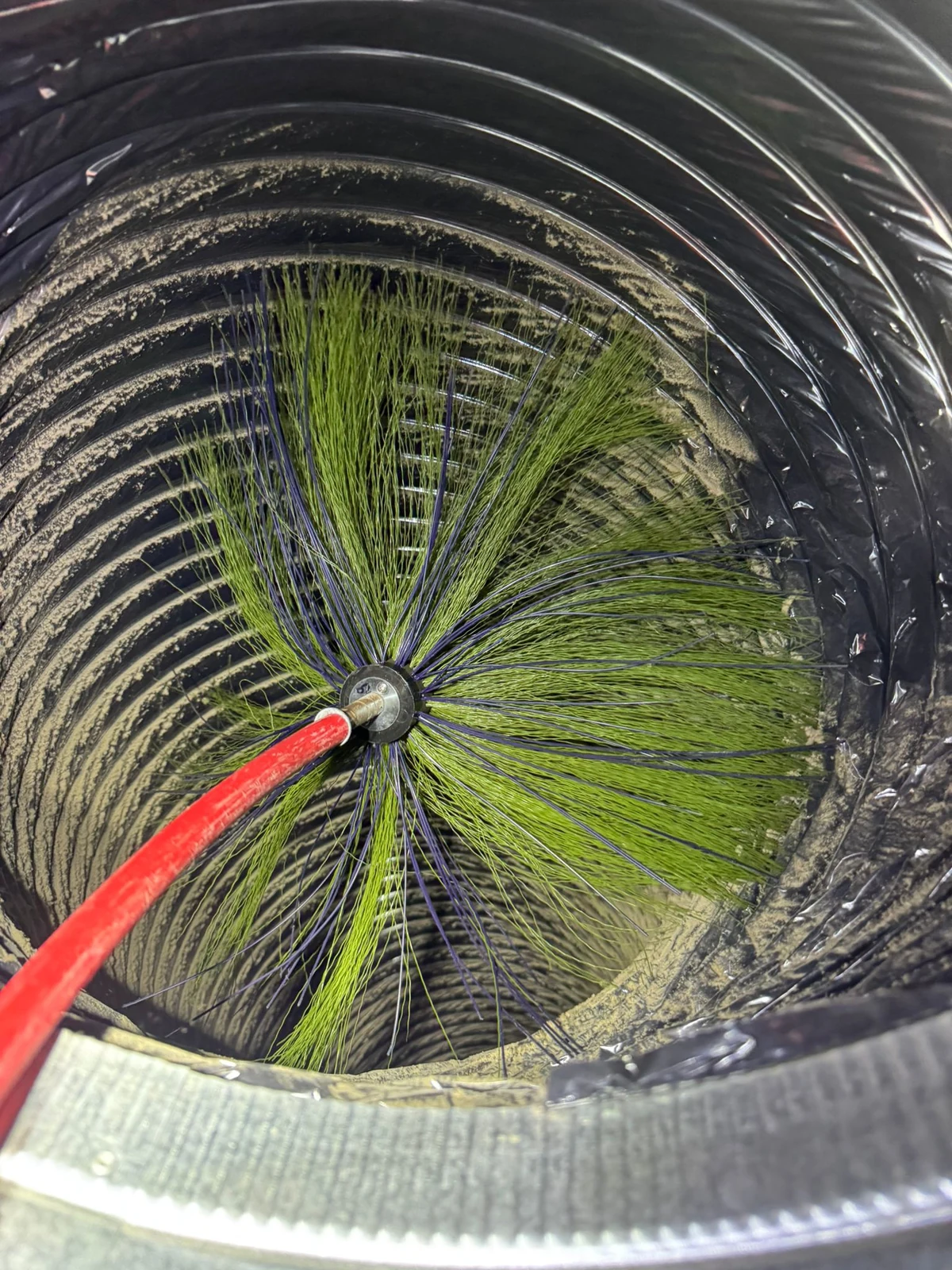
A post-2010 system is usually not dirty in the way people picture. What comes out is the construction phase — drywall fines, sawdust, insulation fiber — that was pulled into open ducts before the house was ever occupied, plus whatever a kinked flex run has been collecting behind the crimp. That is a different cleaning: shorter, more targeted, and far more dependent on the before-and-after photographs, because the difference is not something you can smell.
Do I need to leave the house during the cleaning?
No. The system is sealed and under negative pressure while we work, so dislodged debris travels into the HEPA collector, not your rooms.
Can the tools damage my ductwork?
Tooling is matched to the duct: rotary brushes for sheet metal, gentler air whips for flex. The pre-clean camera pass documents existing damage first, so nothing gets misattributed.
04Book in Cibolo
Three fields, and a person calls you back.
Tell us the ZIP and we will tell you what your system likely needs — including, sometimes, that it needs nothing yet. Nothing is charged until you have approved a written quote.
05Questions
Asked in Cibolo, answered straight.
Do I need to leave the house during the cleaning?
No. The system is sealed and under negative pressure while we work, so dislodged debris travels into the HEPA collector, not your rooms. The HVAC itself is off for the duration — three to five hours — which in summer is the only real inconvenience. Most customers simply work around us.
Can the tools damage my ductwork?
Tooling is matched to the duct: rotary brushes for sheet metal, gentler air whips for flex. The pre-clean camera pass documents existing damage first, so nothing gets misattributed. If a run is too fragile to clean safely, we photograph it, tell you plainly, and leave it alone.
The heat never feels hot at the registers. Is the duct leaking?
Probably not. A heat pump supplies air in the low nineties by design, which feels cool against your hand even while it warms the room. It is still worth checking whether the attic runs are leaking conditioned air and whether the auxiliary heat has been locked out, because both are real and both feel the same from the living room. We measure at the register and at the plenum to separate them.
Upstairs is always hotter than downstairs no matter what we set.
That is the standard finding in a two-story Cibolo house running on one system. Heat rises, the upstairs return is undersized or missing, and the trunk was balanced on paper rather than in the house. Dampers, return capacity and sealing the attic runs are what change it. A cleaning would leave the temperature split exactly where it is, and we will say so before you spend anything.
Our system is twenty years old and we are replacing the outdoor unit.
Have the static pressure measured while the installer is there. A large part of Cibolo went up in the same few years, so a lot of houses are replacing equipment at once, and modern blowers move more air than the trunks and returns of that era were laid out for. Duct that was adequate in 2004 gets loud and inefficient behind new equipment, and this is the one moment when correcting it is cheap.
Last reviewed: