
Duct Sanitizing & Antimicrobial Treatment in Little Elm
EPA-registered antimicrobial treatment — after cleaning, never instead of it.
01Little Elm — the housing record
What Little Elm actually has behind its walls.
Before anyone quotes a duct job here, this is the stock they are quoting against. It is public Census data, and it is different in every city we cover.
- Housing units
- 18,359
- Built pre-1980
- 1%
- Built 2000s
- 45%
- Built since 2010
- 51%
- Gas heat
- 39%
- Electric heat
- 59%
- Single-family
- 73%
U.S. Census Bureau, American Community Survey 5-Year Estimates (2023), tables B25034, B25040 and B25024. Percentages are rounded and describe the city, not your house.
What that means for ducts
New-build ductwork
Roughly 51% of Little Elm's homes were built since 2010. New does not mean clean: the commonest thing we pull out of a five-year-old system is the construction phase itself — drywall fines, sawdust, insulation fiber — plus builder-grade flex that was kinked or crushed on the day and has been throttling that run ever since. Photographs matter more here, not less.
That is a reading of the city’s stock, not a diagnosis of your home. Which of it applies to you is exactly what the camera settles — and why we would rather run one than quote from a postcode.
02Working in Little Elm
The part that changes from street to street.
Little Elm wraps the south end of Lewisville Lake, and water changes the arithmetic on the humid half of the year. Most homes here are recent and run heat pumps rather than furnaces, so the equipment cycles at low temperature for long stretches and the indoor coil stays wet through most of the cooling season. Add lake air and equipment a size larger than the house needs, a common pairing in the newer neighborhoods, and you get short cycles that hit the thermostat quickly without removing much moisture. What people describe as a dirty-duct smell is usually that coil and the first stretch of supply plenum sitting damp between runs, and a cleaning does nothing about the cycling that caused it. There is also housing here with almost nothing in common with the subdivisions. In the townhome rows, an air handler sits in a closet feeding a few short runs, and a quote priced by the vent is billing you for ductwork that was never there. Same city, two completely different conversations about where your money should go.
the Little Elm boardwalk
- Frisco Hills ·
- Sunset Pointe ·
- Paloma Creek ·
- Union Park
County
Denton County
Same standard in Little Elm as everywhere else.
Source removal to the NADCA ACR standard, a written quote before anything is touched, and camera photographs of your own runs before and after. We are not going to re-argue that on every city page — it is set out once, in full, on the service page.
- Surface-prep verification — treatment goes on cleaned ducts only
- EPA-registered, HVAC-labeled product applied per label directions
- Treated areas documented with photos
- Product name and label information left for your records
- From
- $149
- On site
- 45–60 minutes as an add-on
- Scope
- 4 lines
Prices shown are starting estimates and may change with the condition, access, and scope we find on site. Only a written quote from an on-site visit is a price we commit to.
03Duct Sanitizing & Antimicrobial Treatment — in this stock
Treatment in new stock — usually the wrong purchase.
In a house built since 2010 there is rarely a documented indication for an antimicrobial or a UV lamp, and we will normally say so. Where a UV light does earn its place here it is a coil-hygiene decision on a system that runs long humid cycles, not an air-purity claim. If someone has quoted you a treatment on a five-year-old system without showing you a reason on camera, ask what the reason was.
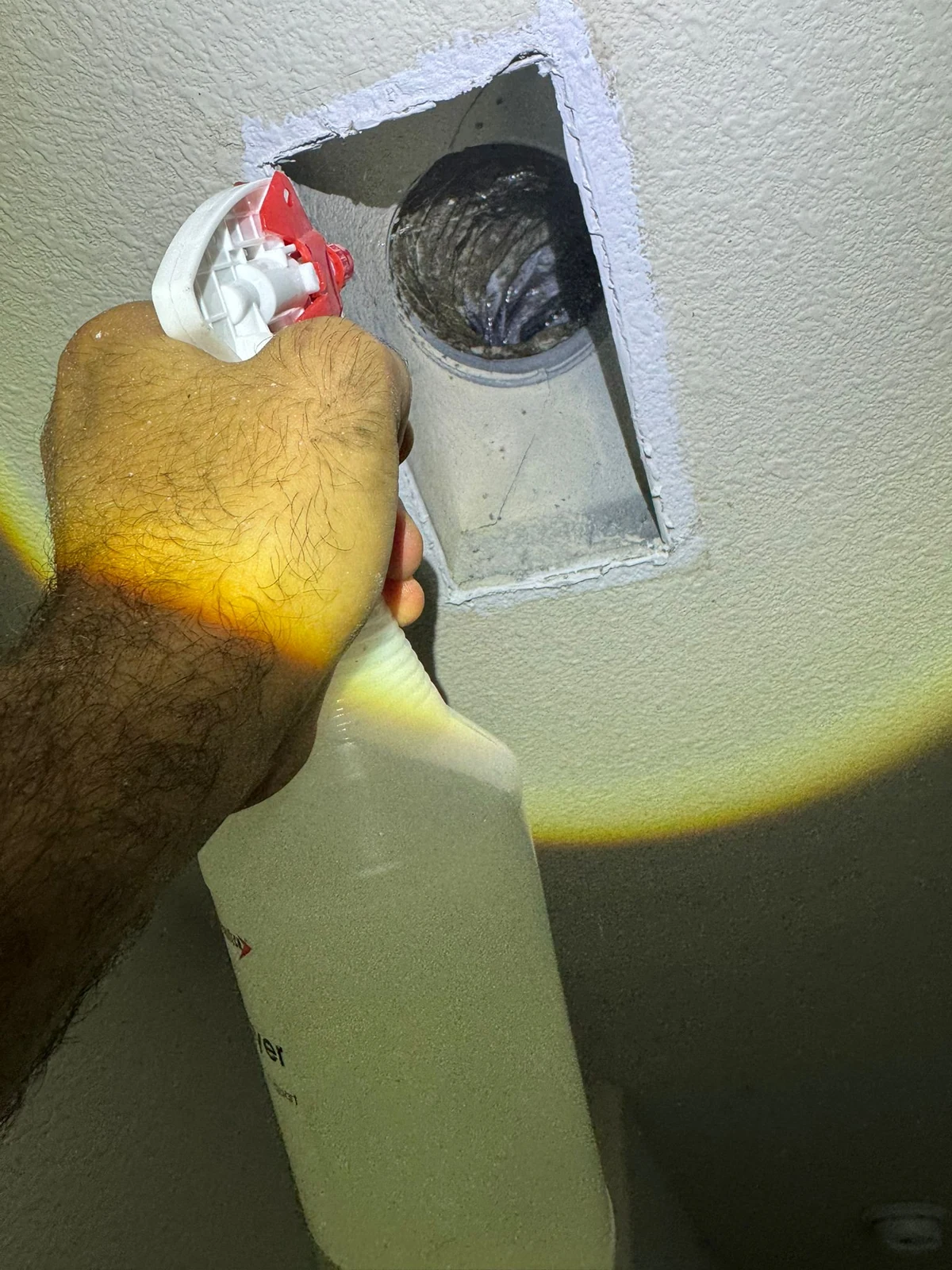
Is the antimicrobial treatment safe for my family and pets?
We only use products EPA-registered specifically for use in HVAC systems, applied exactly as the label directs — including any re-entry and ventilation instructions, which we walk you through before we start. You also get the product name and label documentation for your records.
Why won't you sanitize without cleaning first?
Because fogging product over a layer of dust treats the dust, not the duct surface — the buildup simply shields what's underneath. It wastes your money and violates the spirit of the label.
04Book in Little Elm
Three fields, and a person calls you back.
Tell us the ZIP and we will tell you what your system likely needs — including, sometimes, that it needs nothing yet. Nothing is charged until you have approved a written quote.
05Questions
Asked in Little Elm, answered straight.
Is the antimicrobial treatment safe for my family and pets?
We only use products EPA-registered specifically for use in HVAC systems, applied exactly as the label directs — including any re-entry and ventilation instructions, which we walk you through before we start. You also get the product name and label documentation for your records. No off-label products, no improvised mixes, ever.
Why won't you sanitize without cleaning first?
Because fogging product over a layer of dust treats the dust, not the duct surface — the buildup simply shields what's underneath. It wastes your money and violates the spirit of the label. Source removal first, then treatment where there's a documented indication. Any company that offers it the other way around is selling theater.
The house smells musty when the AC kicks on in August. Are the ducts dirty?
Sometimes, but this close to the lake the first suspect is the wet part of the system. A coil that never fully dries between cycles produces that smell with perfectly clean branch runs downstream of it. We open the coil and check the pan, the trap and the drain before quoting duct work, and if the underlying cause is oversized equipment we will tell you that too.
We keep the thermostat at 74 and the house still feels clammy.
That is a dehumidification problem, and it is common on this side of the lake. Equipment sized for the worst August afternoon satisfies the thermostat in short bursts and never runs long enough to wring water out of the air, so the coil stays wet and the plenum stays damp. Cleaning buys a few weeks. Longer runtime at lower speed treats the actual cause.
Our townhome barely has any ductwork. What is worth doing?
Very little, honestly. The air handler sits in a closet with short runs and a single return, so there is not much for a brush to reach. Filter fit, a sealed return and a clear condensate line are the whole list, and all three together cost less than a cleaning package. We would rather run the inspection and give you a short answer.
Duct Sanitizing & Antimicrobial Treatment nearby
Everything we do in Little ElmLast reviewed: