
Mold Assessment & Referral in Live Oak
We test and document. Remediation goes to a licensed remediator — we never do it ourselves.
01Live Oak — the housing record
What Live Oak actually has behind its walls.
Before anyone quotes a duct job here, this is the stock they are quoting against. It is public Census data, and it is different in every city we cover.
- Housing units
- 7,064
- Built pre-1980
- 12%
- Built 2000s
- 32%
- Built since 2010
- 20%
- Gas heat
- 33%
- Electric heat
- 65%
- Single-family
- 68%
U.S. Census Bureau, American Community Survey 5-Year Estimates (2023), tables B25034, B25040 and B25024. Percentages are rounded and describe the city, not your house.
What that means for ducts
Mixed-era stock
Live Oak splits across build eras — 12% pre-1980, 20% since 2010 — so two houses on the same street can need completely different work. It is the case where guessing from the curb is worst, and where a camera before a quote saves the most money.
That is a reading of the city’s stock, not a diagnosis of your home. Which of it applies to you is exactly what the camera settles — and why we would rather run one than quote from a postcode.
02Working in Live Oak
The part that changes from street to street.
Something close to a third of the housing in this city is not a detached house, and in those buildings the return side is the entire conversation. The air handler sits in a closet with a grille in the door, and the return is frequently not a duct at all. It is the framed closet cavity, stud bays and all, drywalled on three sides with whatever gaps the framer left at the top plate. Everything the blower moves passes through that cavity before it reaches the filter, which is how wall insulation fibers, attic air and a neighbor's cooking end up circulating through a home whose registers look spotless. You cannot brush a stud bay clean. You seal it, and then the filter finally does the job it was bought for. The detached side of the city is 2000s subdivision stock with conventional attic flex and a conventional set of failures: straps biting into the insulation, a branch that has sagged into a low loop, a boot that let go. Those two visits look nothing alike, so we ask which building you are in before quoting anything.
the Live Oak Civic Center
- Forest Bluff ·
- Royal Forest ·
- Live Oak Hills ·
- Woodcrest
County
Bexar County
Same standard in Live Oak as everywhere else.
Source removal to the NADCA ACR standard, a written quote before anything is touched, and camera photographs of your own runs before and after. We are not going to re-argue that on every city page — it is set out once, in full, on the service page.
- Camera pass of every accessible run, both plenums, and the coil compartment
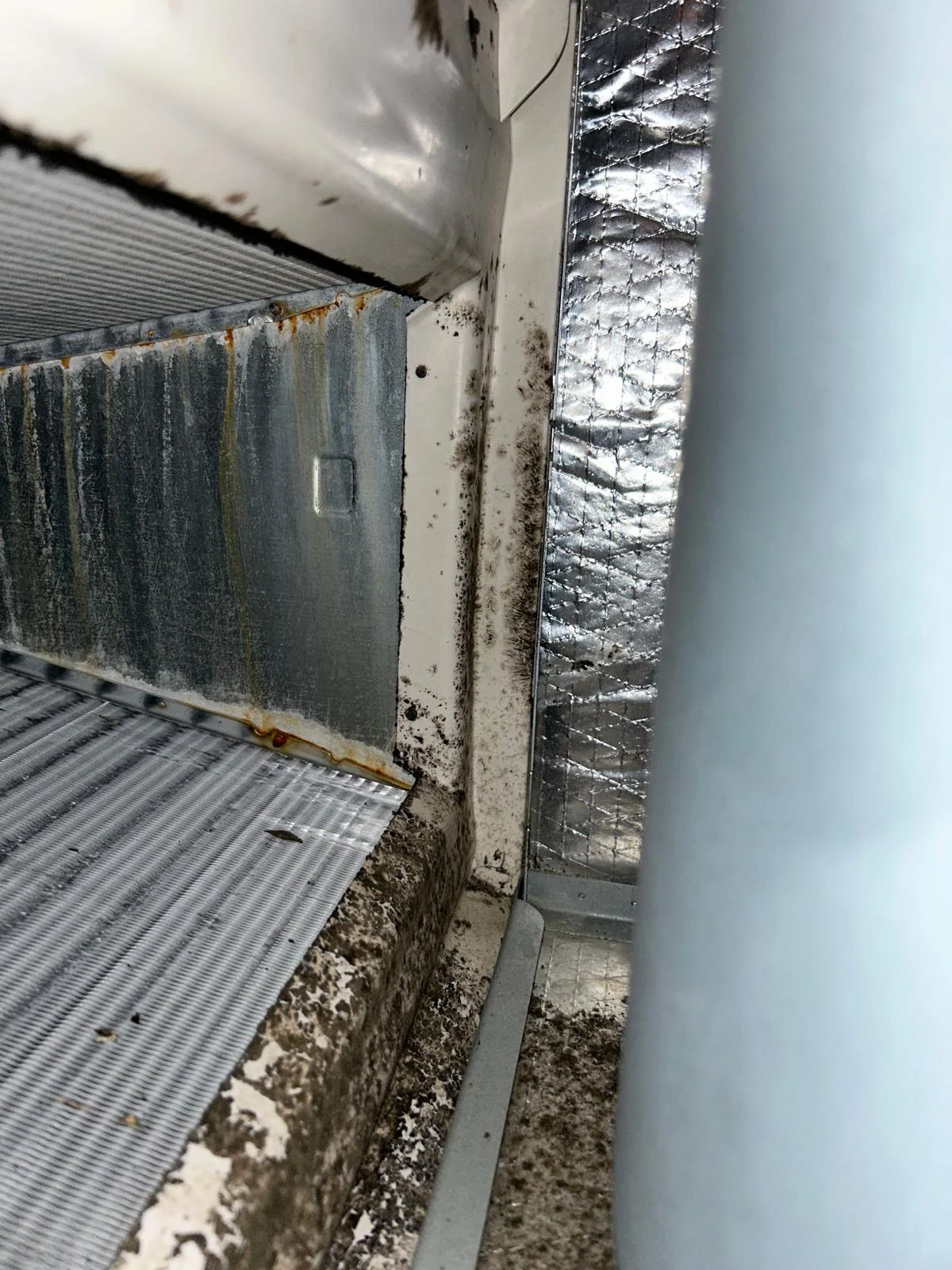
- Moisture and condensate conditions documented with photos and readings
- Surface or air samples submitted to an independent laboratory
- Lab report plus a plain-language summary of what it does and does not show
- Referral to a licensed remediator above the regulated threshold — we never remediate mold ourselves
- From
- $149
- On site
- 90–120 minutes, plus laboratory turnaround
- Scope
- 5 lines
Prices shown are starting estimates and may change with the condition, access, and scope we find on site. Only a written quote from an on-site visit is a price we commit to.
03Mold Assessment & Referral — in this stock
Why the inspection matters most here.
Mixed-era stock is exactly where the inspection earns its keep, because the honest answer genuinely differs house to house and nobody — including us — can tell from the curb. You are buying a verdict with photographs behind it, and you keep the verdict whichever way it goes.
Ask us anything about this on the phone — a person answers during opening hours.
All mold assessment & referral questions04Book in Live Oak
Three fields, and a person calls you back.
Tell us the ZIP and we will tell you what your system likely needs — including, sometimes, that it needs nothing yet. Nothing is charged until you have approved a written quote.
05Questions
Asked in Live Oak, answered straight.
I rent an apartment here. Is there enough ductwork to make cleaning worthwhile?
Often not. In a closet system the duct is short and the leverage sits elsewhere, in filter fit and in whether the return cavity behind that door grille is sealed. Neither of those is a tenant repair, which is the awkward part. What we can give you is photographs and a written finding, and that is what actually moves a property manager to authorize the work.
The registers look clean but the place feels dusty and smells like other people's cooking.
That points at the return, not the supply. An unsealed closet return draws through stud bays and the top plate, so it collects wall cavity air, attic air and whatever migrates between units, all of it upstream of your filter. Cleaning the duct will not change it. Sealing the cavity and fitting the filter properly usually does, and the difference is noticeable within days.
Our townhome is from the mid 2000s. What should we expect?
A normal attic system that is now old enough to inspect properly. We look at strap compression, sagging runs and boot connections, then decide with you whether anything needs cleaning at all. Twenty years is a fair time for a first look, but age on its own is not a finding, and if the footage is clean we will say so.
Mold Assessment & Referral nearby
Everything we do in Live OakLast reviewed: