
New-Construction Duct Dust-Out in Ennis
Construction debris out of the ducts before you move in.
01Ennis — the housing record
What Ennis actually has behind its walls.
Before anyone quotes a duct job here, this is the stock they are quoting against. It is public Census data, and it is different in every city we cover.
- Housing units
- 8,304
- Built pre-1980
- 30%
- Built 2000s
- 35%
- Built since 2010
- 11%
- Gas heat
- 25%
- Electric heat
- 70%
- Single-family
- 74%
U.S. Census Bureau, American Community Survey 5-Year Estimates (2023), tables B25034, B25040 and B25024. Percentages are rounded and describe the city, not your house.
What that means for ducts
Retrofit-era ductwork
About 30% of Ennis's homes went up before 1980, which is before central air was designed into a house rather than added to it. Duct runs in that stock were threaded through attics and crawl spaces after the fact, often more than once, and the flex in them has had decades of Texas attic heat. Expect route surprises, expect joints that have worked loose, and expect a system nobody has opened.
That is a reading of the city’s stock, not a diagnosis of your home. Which of it applies to you is exactly what the camera settles — and why we would rather run one than quote from a postcode.
02Working in Ennis
The part that changes from street to street.
Ennis sits in open Ellis County farmland and that shows up inside the systems here. When the fields are worked in spring and again at harvest, what drifts into town is a fine gritty soil dust rather than the soft household dust we pull out of a city house, and it comes in through the return side and through gaps in the envelope, not from anything happening in your living room. About a third of the housing goes back before 1980, and those homes usually still run their original sheet-metal trunk with flex branches spliced on later, often when window units were retired for a central system. Those splice points are where we find loose connections, failed tape and debris that has been sitting for decades. Newer Ennis, the 2000s subdivisions, is standard attic flex. Most of the town heats electrically, so there is no burner or flue in the picture and the coil is the component that decides whether the air smells right.
the Ennis Bluebonnet Trails
Same standard in Ennis as everywhere else.
Source removal to the NADCA ACR standard, a written quote before anything is touched, and camera photographs of your own runs before and after. We are not going to re-argue that on every city page — it is set out once, in full, on the service page.
- Full-system source removal tuned to drywall and construction fines
- Both plenums cleared and a fresh filter installed
- Camera verification photos of the finished runs
- Builder- and closing-ready completion report
- From
- $449
- On site
- 3–5 hours
- Scope
- 4 lines
Prices shown are starting estimates and may change with the condition, access, and scope we find on site. Only a written quote from an on-site visit is a price we commit to.
03New-Construction Duct Dust-Out — in this stock
Renovation dust in an old system.
A remodel in older stock pushes fines into ductwork that was already carrying decades of settled load, and the two mix. That matters for scope: this is rarely a register-level clean-up, because the debris travels back to plenums that have never been opened. It is also the one moment where a full system clean is unambiguously worth doing — the reservoir is at its worst and the house is already disrupted.
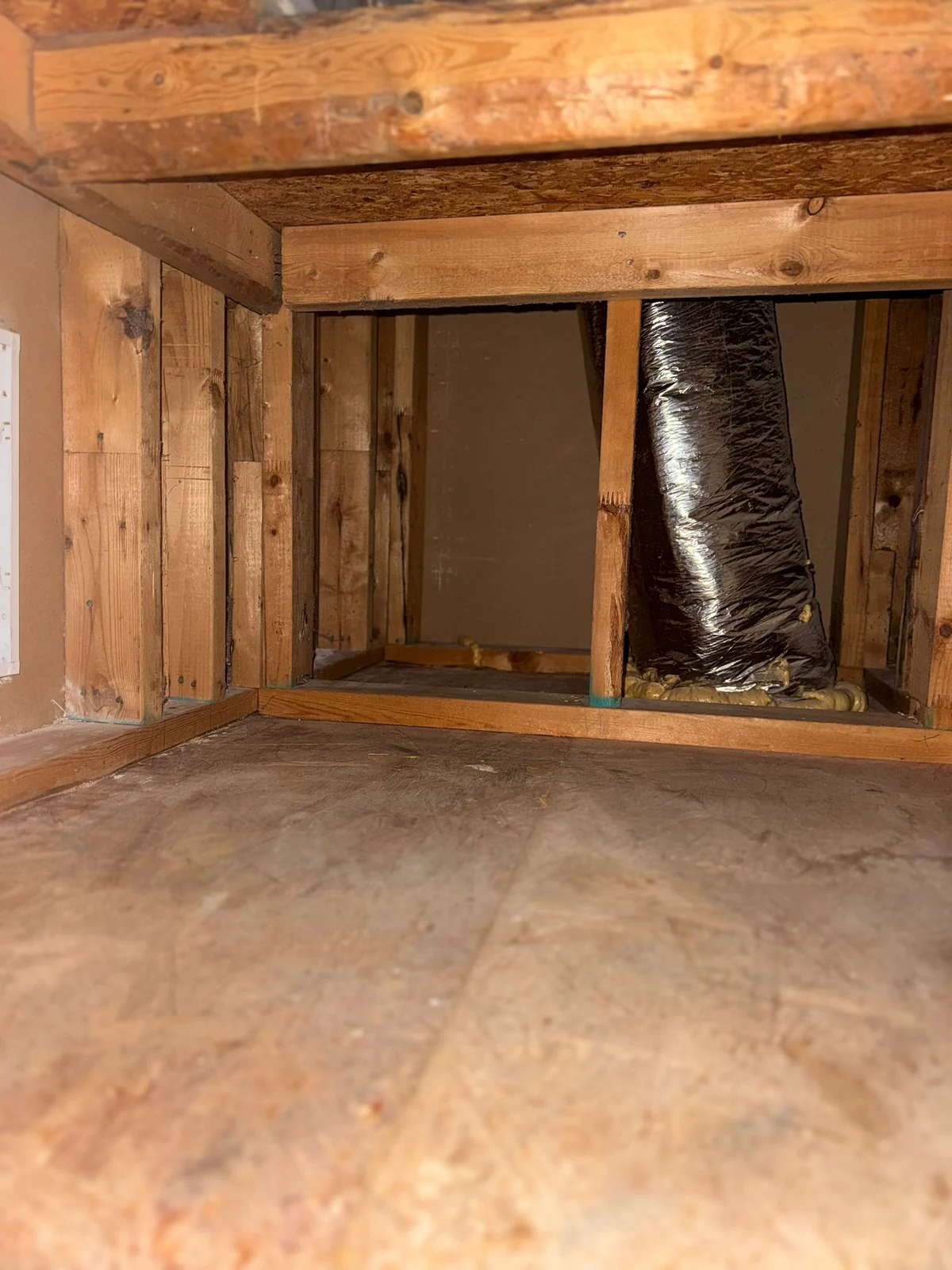
Shouldn't my builder have cleaned the ducts already?
Sometimes it's in the contract; often it's skipped or done superficially in the rush to closing. Ask your builder for documentation — an invoice and photos.
When is the ideal time to schedule a dust-out?
After the final sanding and paint work, before move-in — that's when the ducts have collected everything they're going to collect and your belongings aren't in the way. Already moved in? Still absolutely worth doing; the work is identical, we just add drop cloths and a little more care around furniture..
04Book in Ennis
Three fields, and a person calls you back.
Tell us the ZIP and we will tell you what your system likely needs — including, sometimes, that it needs nothing yet. Nothing is charged until you have approved a written quote.
05Questions
Asked in Ennis, answered straight.
Shouldn't my builder have cleaned the ducts already?
Sometimes it's in the contract; often it's skipped or done superficially in the rush to closing. Ask your builder for documentation — an invoice and photos. If they can't produce it, our camera answers the question in an hour, and the pre-clean photos give you standing to raise it before your warranty window closes.
When is the ideal time to schedule a dust-out?
After the final sanding and paint work, before move-in — that's when the ducts have collected everything they're going to collect and your belongings aren't in the way. Already moved in? Still absolutely worth doing; the work is identical, we just add drop cloths and a little more care around furniture.
Every spring the fields get worked and the house fills with dust. Will a cleaning stop it?
No, and we would rather say that up front. Cleaning removes what has already settled in the system. It does nothing about the next week of field dust, which keeps arriving through return leaks and the envelope. Sealing the return side and fitting a filter that actually seals in its rack does considerably more for you.
Our house is from the 1960s and the ducts are metal. Is that better or worse than flex?
Better, mostly. Rigid metal takes a brush without damage and does not sag or tear the way aging flex does. The weak points in these Ennis houses are the joints, the boots where metal meets the ceiling, and whatever flex was grafted on later. That is what we scope, and it is usually a sealing job rather than a cleaning one.
Our 1960s house has one big return grille in the hallway and none in the bedrooms. Does that matter?
It matters with the doors shut. With a single central return, a closed bedroom cannot send its air back to the system, so the room pressurizes and the rest of the house makes up the difference by pulling from the attic and wall cavities. That is how attic dust ends up in ducts you just paid to clean. A transfer path or undercut doors fix more than we could.
Last reviewed: