
Duct Odor Investigation in League City
Trace musty, stale, or animal odors to their real source.
01League City — the housing record
What League City actually has behind its walls.
Before anyone quotes a duct job here, this is the stock they are quoting against. It is public Census data, and it is different in every city we cover.
- Housing units
- 44,280
- Built pre-1980
- 7%
- Built 2000s
- 48%
- Built since 2010
- 25%
- Gas heat
- 57%
- Electric heat
- 41%
- Single-family
- 77%
U.S. Census Bureau, American Community Survey 5-Year Estimates (2023), tables B25034, B25040 and B25024. Percentages are rounded and describe the city, not your house.
What that means for ducts
Mixed-era stock
League City splits across build eras — 7% pre-1980, 25% since 2010 — so two houses on the same street can need completely different work. It is the case where guessing from the curb is worst, and where a camera before a quote saves the most money.
That is a reading of the city’s stock, not a diagnosis of your home. Which of it applies to you is exactly what the camera settles — and why we would rather run one than quote from a postcode.
02Working in League City
The part that changes from street to street.
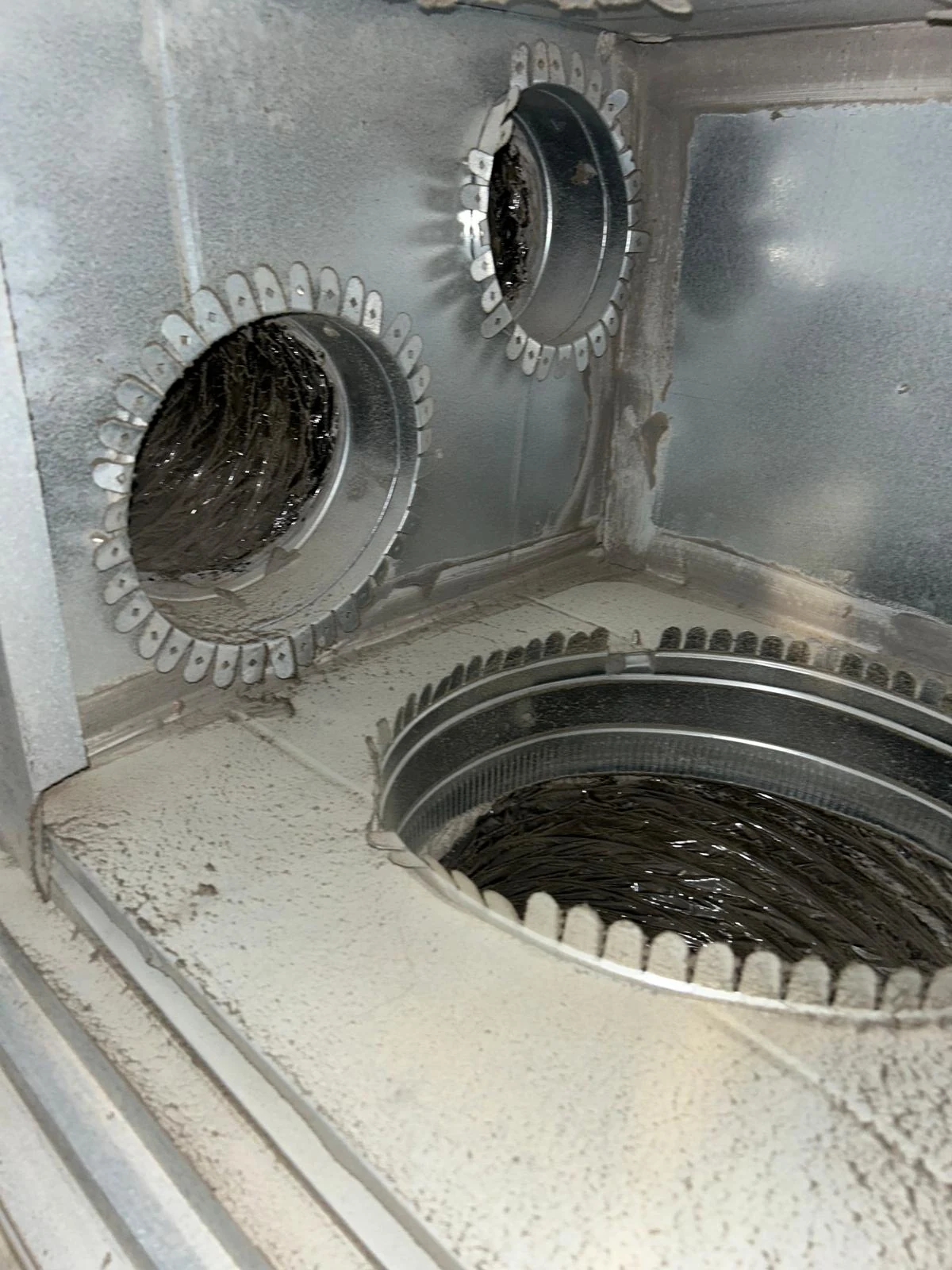
League City is close enough to the bay that humidity rather than dust is the real subject here. Nearly three-quarters of the housing has gone up since 2000, so the duct itself is relatively young, but young flex in a Gulf Coast attic still sweats where the insulation on a boot has compressed or a joint has lost its seal, and cold supply air moving through warm damp attic air will find whatever weakness you have. What we deal with most in this city is biological, and it starts at the evaporator coil and the drain pan rather than out in the branches. A coil that stays wet most of the year, on a condensate line that drains slowly, is where the smell people call us about actually begins. Gas heat is the majority here and those furnaces run a handful of days a year, which leaves the cabinet sitting in damp air for the other eleven months. Cleaning a hundred feet of branch duct while leaving that alone is work at the wrong end of the system.
the South Shore Harbour marina
- South Shore Harbour ·
- Tuscan Lakes ·
- Mar Bella ·
- Westover Park
County
Galveston County
Same standard in League City as everywhere else.
Source removal to the NADCA ACR standard, a written quote before anything is touched, and camera photographs of your own runs before and after. We are not going to re-argue that on every city page — it is set out once, in full, on the service page.
- Full camera pass of accessible runs and both plenums
- Moisture and animal-intrusion check with photos
- The source identified — or your ductwork ruled out — in writing
- A firm-priced fix recommendation, ours or another trade's
- From
- $99
- On site
- 60–120 minutes
- Scope
- 4 lines
Prices shown are starting estimates and may change with the condition, access, and scope we find on site. Only a written quote from an on-site visit is a price we commit to.
03Duct Odor Investigation — in this stock
Why the inspection matters most here.
Mixed-era stock is exactly where the inspection earns its keep, because the honest answer genuinely differs house to house and nobody — including us — can tell from the curb. You are buying a verdict with photographs behind it, and you keep the verdict whichever way it goes.
What if the smell turns out not to be the ducts?
Then that's exactly what we tell you, in writing, with the footage that rules the ductwork out — plus our best read on where to look next, whether that's plumbing, the attic itself, or HVAC equipment. You've spent $99 to eliminate the most complicated suspect.
Can you get rid of a dead-animal smell in the ducts?
Yes — locate it on camera, remove it, source-clean the affected run, and where indicated apply an EPA-registered treatment. One honest caveat: after removal, residual odor takes some days to fully dissipate as the system airs out.
04Book in League City
Three fields, and a person calls you back.
Tell us the ZIP and we will tell you what your system likely needs — including, sometimes, that it needs nothing yet. Nothing is charged until you have approved a written quote.
05Questions
Asked in League City, answered straight.
What if the smell turns out not to be the ducts?
Then that's exactly what we tell you, in writing, with the footage that rules the ductwork out — plus our best read on where to look next, whether that's plumbing, the attic itself, or HVAC equipment. You've spent $99 to eliminate the most complicated suspect. We'd rather be right than busy.
Can you get rid of a dead-animal smell in the ducts?
Yes — locate it on camera, remove it, source-clean the affected run, and where indicated apply an EPA-registered treatment. One honest caveat: after removal, residual odor takes some days to fully dissipate as the system airs out. Anyone promising instant scentlessness is overselling; we'll give you the realistic timeline.
There is a musty smell for the first minute after the AC starts. Are the ducts dirty?
Probably not the ducts. That specific pattern, strong at startup and gone shortly after, points at the evaporator coil and the pan below it, which in this climate stay wet for most of the year. We open the cabinet and photograph the coil face. If it is clean we keep looking. If it is not, cleaning the branches would have solved nothing.
Does the salt air off the bay get into the system?
Not the way people expect. Salt does its damage outdoors, on the condenser coil and its cabinet, and that is an HVAC service item rather than a duct one. Indoors the coastal factor is moisture, not salt. If someone is selling you an indoor treatment because you live near the water, ask them what exactly they are treating.
Should we leave the fan on all the time to keep air moving?
Not here in summer. With the fan running continuously, air keeps passing over a coil that is still wet after the compressor stops, and that moisture goes straight back into the house. On the Gulf Coast that raises indoor humidity rather than improving air quality. Leave it on auto and let the coil drain between cycles.
Last reviewed: