
Plenum & Return-Box Cleaning in Rhome
Deep cleaning of the distribution boxes at your air handler.
01Rhome — the housing record
What Rhome actually has behind its walls.
Before anyone quotes a duct job here, this is the stock they are quoting against. It is public Census data, and it is different in every city we cover.
- Housing units
- 685
- Built pre-1980
- 13%
- Built 2000s
- 59%
- Built since 2010
- 14%
- Gas heat
- 16%
- Electric heat
- 79%
- Single-family
- 75%
U.S. Census Bureau, American Community Survey 5-Year Estimates (2023), tables B25034, B25040 and B25024. Percentages are rounded and describe the city, not your house.
What that means for ducts
Mixed-era stock
Rhome splits across build eras — 13% pre-1980, 14% since 2010 — so two houses on the same street can need completely different work. It is the case where guessing from the curb is worst, and where a camera before a quote saves the most money.
That is a reading of the city’s stock, not a diagnosis of your home. Which of it applies to you is exactly what the camera settles — and why we would rather run one than quote from a postcode.
02Working in Rhome
The part that changes from street to street.
Rhome is a small Wise County town where close to one home in five is manufactured housing, and that single fact decides how most of this work goes. A manufactured home has no attic full of flex. The supply trunk runs inside the floor cavity, and where a double wide is joined, a crossover duct is slung underneath between the halves inside the belly board. That duct lives outdoors in every way that counts. We find it torn open by animals, sagging into standing water after a wet stretch, and holding the fiberglass that dropped out of the belly wrap above it, and none of that is visible from inside the house. It reads as a floor register that barely blows and a power bill that makes no sense. The site-built houses in town are mostly from the 2000s and follow the ordinary attic-flex pattern. Nearly everything in Rhome is electric, so there is no burner and no flue, just one cabinet with a coil and heat strips in it.
the US 287 corridor through town
Same standard in Rhome as everywhere else.
Source removal to the NADCA ACR standard, a written quote before anything is touched, and camera photographs of your own runs before and after. We are not going to re-argue that on every city page — it is set out once, in full, on the service page.
- Supply and return plenums HEPA-vacuumed and hand-wiped
- Liner and insulation condition inspected and photographed
- Access panels resealed with UL 181-listed foil tape
- Fresh filter installed on request
- From
- $199
- On site
- 1–2 hours
- Scope
- 4 lines
Prices shown are starting estimates and may change with the condition, access, and scope we find on site. Only a written quote from an on-site visit is a price we commit to.
03Plenum & Return-Box Cleaning — in this stock
Cleaning where the street does not tell you the answer.
This is the stock where two houses forty feet apart genuinely need different work — one built when ducts were retrofitted, one built when they were designed in. Quoting a cleaning from an address here is guessing. It is the single strongest case for putting a camera in first and letting the footage decide whether you are buying a full system or two runs.
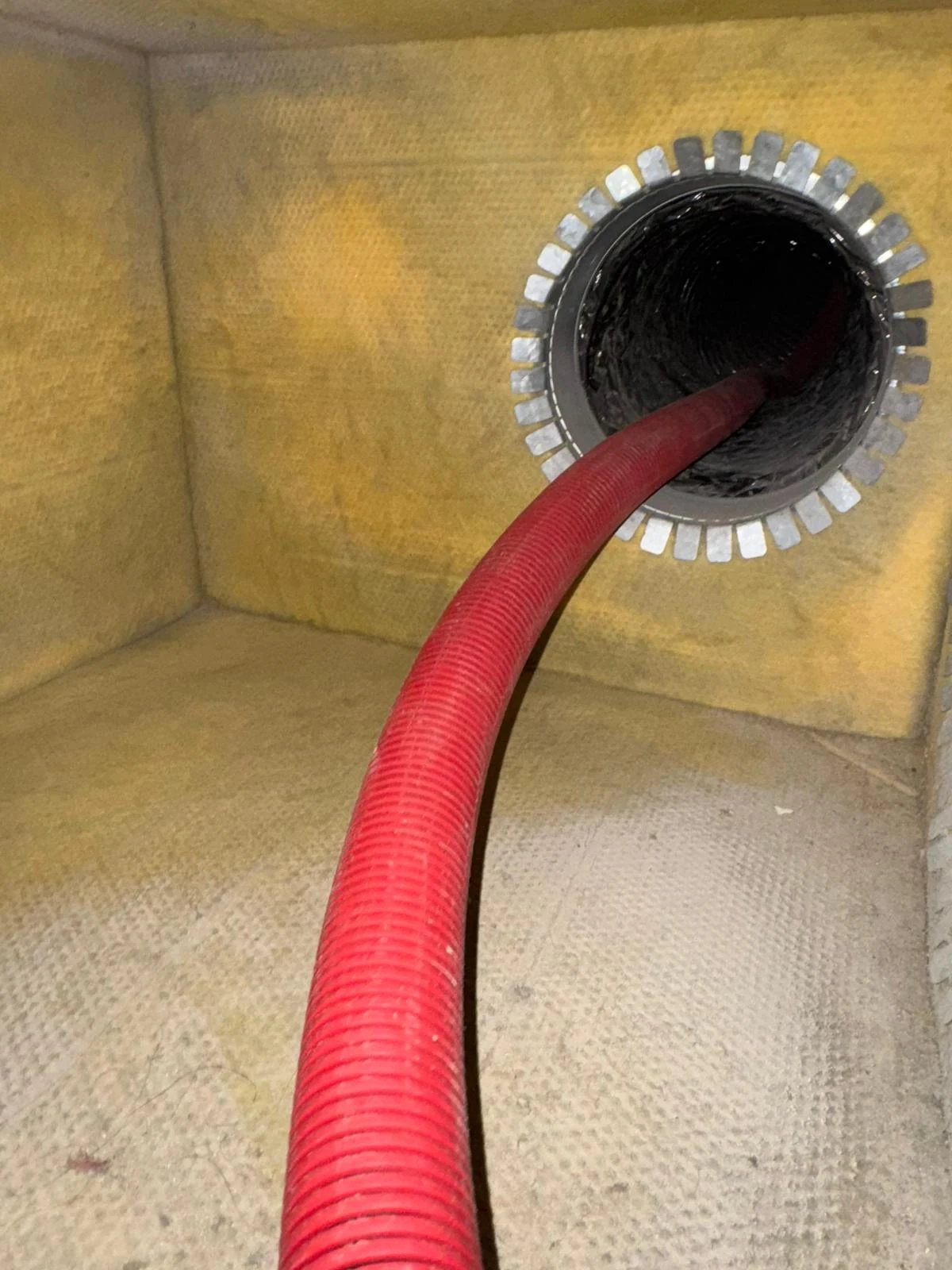
What if the plenum liner is in bad shape?
We stop and show you rather than bill for a cleaning that can't help. Degraded or moldy duct-board liner can't be restored by cleaning — EPA guidance is clear that porous materials in that condition need replacement, which is HVAC-contractor work.
Can you clean just the plenums without doing the whole system?
Yes — that's precisely what this service is. The plenums are the highest-traffic surfaces in the system, so cleaning them alone delivers outsized value on older systems, from $199.
04Book in Rhome
Three fields, and a person calls you back.
Tell us the ZIP and we will tell you what your system likely needs — including, sometimes, that it needs nothing yet. Nothing is charged until you have approved a written quote.
05Questions
Asked in Rhome, answered straight.
What if the plenum liner is in bad shape?
We stop and show you rather than bill for a cleaning that can't help. Degraded or moldy duct-board liner can't be restored by cleaning — EPA guidance is clear that porous materials in that condition need replacement, which is HVAC-contractor work. Our photos give you exactly what that conversation needs.
Can you clean just the plenums without doing the whole system?
Yes — that's precisely what this service is. The plenums are the highest-traffic surfaces in the system, so cleaning them alone delivers outsized value on older systems, from $199. If the camera later shows the runs need work too, that's a separate, honest conversation with evidence attached.
One floor vent in our manufactured home barely blows anything. What is wrong?
Usually the crossover duct underneath, or the branch feeding that end of the trunk. The crossover is the most damaged component in these homes because it hangs under the floor where animals and weather reach it. Diagnosing it means going underneath with the belly board opened, not guessing from the register.
Can a manufactured home's ducts be cleaned the same way as a regular house?
The principle is the same and the tooling is not. Floor trunks and crossover ducts need gentler equipment and lower pressure than an attic system. There is also an honest limit worth knowing: if the belly wrap is open or the crossover is torn, cleaning first is wasted money. The repair comes first and the cleaning after, if it is still warranted.
We hear something moving around under the floor. Should we be worried about the ducts?
Yes, and this is one of the few situations where cleaning is clearly justified rather than optional. Rodents get into a torn belly and then into the duct, and what they leave behind is blown into the house every time the system runs. We inspect from below, close the entry point, then clean. Doing it in the other order means doing it twice.