
Register & Grille Deep Clean in Buda
Every register, grille, and duct boot washed and re-seated.
01Buda — the housing record
What Buda actually has behind its walls.
Before anyone quotes a duct job here, this is the stock they are quoting against. It is public Census data, and it is different in every city we cover.
- Housing units
- 6,058
- Built pre-1980
- 2%
- Built 2000s
- 35%
- Built since 2010
- 55%
- Gas heat
- 47%
- Electric heat
- 51%
- Single-family
- 84%
U.S. Census Bureau, American Community Survey 5-Year Estimates (2023), tables B25034, B25040 and B25024. Percentages are rounded and describe the city, not your house.
What that means for ducts
New-build ductwork
Roughly 55% of Buda's homes were built since 2010. New does not mean clean: the commonest thing we pull out of a five-year-old system is the construction phase itself — drywall fines, sawdust, insulation fiber — plus builder-grade flex that was kinked or crushed on the day and has been throttling that run ever since. Photographs matter more here, not less.
That is a reading of the city’s stock, not a diagnosis of your home. Which of it applies to you is exactly what the camera settles — and why we would rather run one than quote from a postcode.
02Working in Buda
The part that changes from street to street.
More than half of Buda has been built since 2010, which means most of these houses came with a component older houses do not have and most owners have never had pointed out to them: a fresh air intake duct tied into the return. Recent energy code closes a house tightly enough that it needs deliberate outdoor air, so the builder ran a small duct from a hood on an outside wall into the return side, sometimes with a motorized damper and a control, sometimes with nothing at all. It is the one opening in your system designed to bring in unfiltered outdoor air, and in most Buda houses we open, nobody has ever looked at it. A damper stuck open pours humid Hays County air across the coil all August, and a hood packed with dust and insects does the same job dirtier. The rest of the city is 2000s construction, now old enough for a first honest inspection, and heat splits close to evenly between furnaces and heat pumps.
the Buda Mill and Grain complex
- Garlic Creek ·
- Whispering Hollow ·
- Sunfield ·
- Historic Buda
County
Hays County
Same standard in Buda as everywhere else.
Source removal to the NADCA ACR standard, a written quote before anything is touched, and camera photographs of your own runs before and after. We are not going to re-argue that on every city page — it is set out once, in full, on the service page.
- All supply registers and return grilles removed and washed
- Boots and the first reach of each run HEPA-vacuumed
- Gasket and fit check, with everything re-seated square
- Written note of any damage, rust, or corrosion spotted
- From
- $99
- On site
- 1–2 hours
- Scope
- 4 lines
Prices shown are starting estimates and may change with the condition, access, and scope we find on site. Only a written quote from an on-site visit is a price we commit to.
03Register & Grille Deep Clean — in this stock
Cleaning a system that is still carrying its own build.
A post-2010 system is usually not dirty in the way people picture. What comes out is the construction phase — drywall fines, sawdust, insulation fiber — that was pulled into open ducts before the house was ever occupied, plus whatever a kinked flex run has been collecting behind the crimp. That is a different cleaning: shorter, more targeted, and far more dependent on the before-and-after photographs, because the difference is not something you can smell.
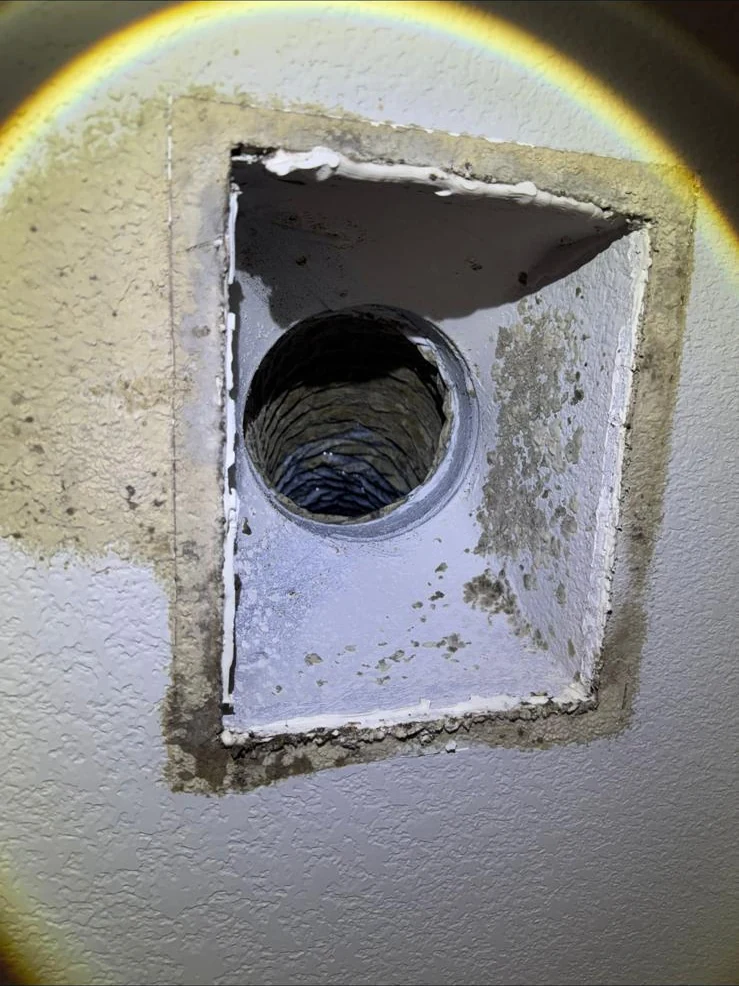
Why are there dark streaks on the ceiling around my vents?
Air exiting a register drags fine particles along the adjacent surface, and over months they deposit as gray-black streaking — worse when gaskets have failed and air leaks around the frame. Washing the registers, vacuuming the boots, and re-seating with fresh gasket usually resolves it; recurring streaks are a reason to camera the ducts..
Does this service clean the ducts themselves?
Only the first reach — the boots and the beginning of each run, as far as boundary tooling properly reaches. It's honest maintenance for the system's visible edge, not a substitute for source-removal cleaning.
04Book in Buda
Three fields, and a person calls you back.
Tell us the ZIP and we will tell you what your system likely needs — including, sometimes, that it needs nothing yet. Nothing is charged until you have approved a written quote.
05Questions
Asked in Buda, answered straight.
Why are there dark streaks on the ceiling around my vents?
Air exiting a register drags fine particles along the adjacent surface, and over months they deposit as gray-black streaking — worse when gaskets have failed and air leaks around the frame. Washing the registers, vacuuming the boots, and re-seating with fresh gasket usually resolves it; recurring streaks are a reason to camera the ducts.
Does this service clean the ducts themselves?
Only the first reach — the boots and the beginning of each run, as far as boundary tooling properly reaches. It's honest maintenance for the system's visible edge, not a substitute for source-removal cleaning. Pair it with a $99 camera inspection if you want to know what the deeper runs look like.
There is a small duct running into our return that nobody ever explained.
That is almost certainly your fresh air intake, and it is supposed to be there. What is worth checking is whether it has a damper, whether that damper still moves, and what condition the outside hood is in. An intake stuck wide open in summer is a genuine load on the coil and a genuine humidity problem, and closing it seasonally costs nothing if the control is manual.
The house is humid even though the AC keeps up on temperature.
In a Buda house of this vintage the intake is the first thing we look at. Bringing outdoor air in at full flow through a Hays County August holds indoor humidity up no matter how well the equipment cools. A duct cleaning does nothing for that, and we would rather rule the intake in or out before anyone spends money on the duct interior.
Our house was finished in 2013. Is it too early for a cleaning?
Almost certainly, and we say that a lot here. Systems that age are clean from use. What is worth an hour is confirming the boots were cleared before the registers went on, checking the intake and its damper, and looking at the coil and the drain. If those are sound we will tell you to leave the duct alone and have it looked at again in a few years.
Last reviewed: