
Register & Grille Deep Clean in Haslet
Every register, grille, and duct boot washed and re-seated.
01Haslet — the housing record
What Haslet actually has behind its walls.
Before anyone quotes a duct job here, this is the stock they are quoting against. It is public Census data, and it is different in every city we cover.
- Housing units
- 991
- Built pre-1980
- 5%
- Built 2000s
- 31%
- Built since 2010
- 42%
- Gas heat
- 26%
- Electric heat
- 65%
- Single-family
- 99%
U.S. Census Bureau, American Community Survey 5-Year Estimates (2023), tables B25034, B25040 and B25024. Percentages are rounded and describe the city, not your house.
What that means for ducts
New-build ductwork
Roughly 42% of Haslet's homes were built since 2010. New does not mean clean: the commonest thing we pull out of a five-year-old system is the construction phase itself — drywall fines, sawdust, insulation fiber — plus builder-grade flex that was kinked or crushed on the day and has been throttling that run ever since. Photographs matter more here, not less.
That is a reading of the city’s stock, not a diagnosis of your home. Which of it applies to you is exactly what the camera settles — and why we would rather run one than quote from a postcode.
02Working in Haslet
The part that changes from street to street.
There are not many houses inside the Haslet city limits and nearly all of them are detached, most built in the last twenty-five years out in Sendera Ranch, Pearson Ranch and Saratoga. Electric equipment is the norm, so an inspection here concerns the coil, the pan and the drain rather than a burner and a flue. The variable that separates this place from the subdivisions closer to town is entirely outside. This is open north Tarrant prairie against the Alliance corridor, with far less canopy than a mature neighborhood and a steady amount of ground being turned within a few miles in every direction. Fine soil dust travels here in a way it does not on a shaded street of forty-year-old oaks, and a vented attic fills with it. That only becomes your problem where the return side leaks, and in these builds it leaks somewhere. Which is why the first part of a Haslet visit goes to finding out where your system is actually drawing air from, before anyone talks about brushing a supply run.
Haslet Town Hall
Same standard in Haslet as everywhere else.
Source removal to the NADCA ACR standard, a written quote before anything is touched, and camera photographs of your own runs before and after. We are not going to re-argue that on every city page — it is set out once, in full, on the service page.
- All supply registers and return grilles removed and washed
- Boots and the first reach of each run HEPA-vacuumed
- Gasket and fit check, with everything re-seated square
- Written note of any damage, rust, or corrosion spotted
- From
- $99
- On site
- 1–2 hours
- Scope
- 4 lines
Prices shown are starting estimates and may change with the condition, access, and scope we find on site. Only a written quote from an on-site visit is a price we commit to.
03Register & Grille Deep Clean — in this stock
Cleaning a system that is still carrying its own build.
A post-2010 system is usually not dirty in the way people picture. What comes out is the construction phase — drywall fines, sawdust, insulation fiber — that was pulled into open ducts before the house was ever occupied, plus whatever a kinked flex run has been collecting behind the crimp. That is a different cleaning: shorter, more targeted, and far more dependent on the before-and-after photographs, because the difference is not something you can smell.
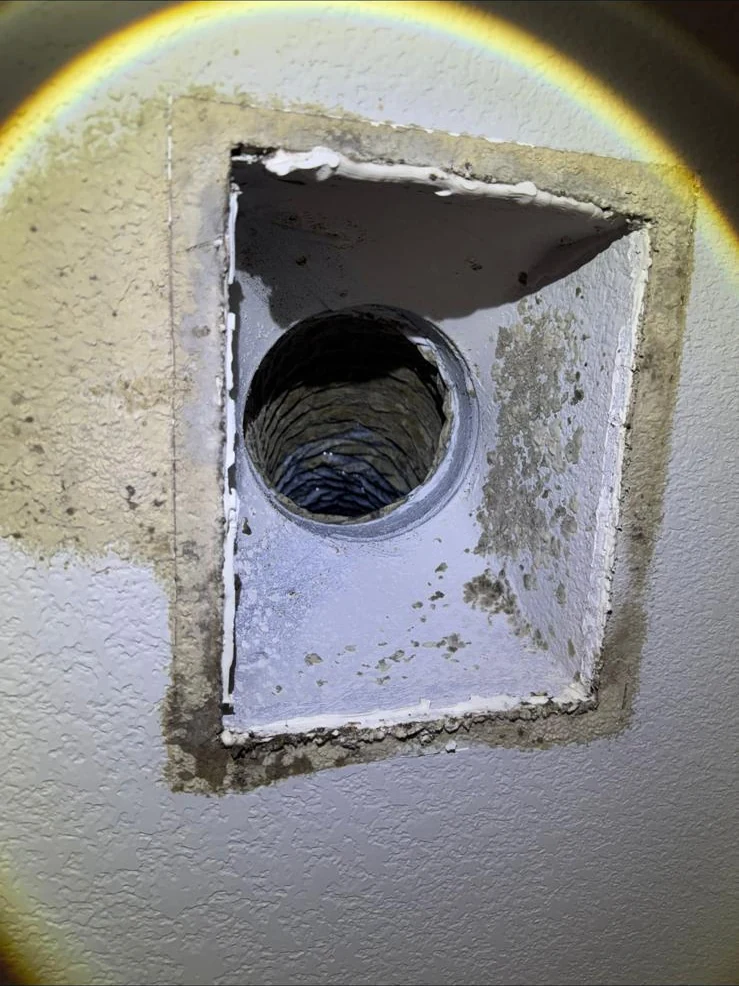
Why are there dark streaks on the ceiling around my vents?
Air exiting a register drags fine particles along the adjacent surface, and over months they deposit as gray-black streaking — worse when gaskets have failed and air leaks around the frame. Washing the registers, vacuuming the boots, and re-seating with fresh gasket usually resolves it; recurring streaks are a reason to camera the ducts..
Does this service clean the ducts themselves?
Only the first reach — the boots and the beginning of each run, as far as boundary tooling properly reaches. It's honest maintenance for the system's visible edge, not a substitute for source-removal cleaning.
04Book in Haslet
Three fields, and a person calls you back.
Tell us the ZIP and we will tell you what your system likely needs — including, sometimes, that it needs nothing yet. Nothing is charged until you have approved a written quote.
05Questions
Asked in Haslet, answered straight.
Why are there dark streaks on the ceiling around my vents?
Air exiting a register drags fine particles along the adjacent surface, and over months they deposit as gray-black streaking — worse when gaskets have failed and air leaks around the frame. Washing the registers, vacuuming the boots, and re-seating with fresh gasket usually resolves it; recurring streaks are a reason to camera the ducts.
Does this service clean the ducts themselves?
Only the first reach — the boots and the beginning of each run, as far as boundary tooling properly reaches. It's honest maintenance for the system's visible edge, not a substitute for source-removal cleaning. Pair it with a $99 camera inspection if you want to know what the deeper runs look like.
We dust twice a week and it comes straight back.
That is the pattern out here and it is rarely solved by cleaning ducts. A leaky return in a vented attic pulls fine prairie soil and loose insulation into the airstream ahead of the filter, so the system redistributes it faster than anyone can wipe. We find the leak, seal it, then decide whether a cleaning is still worth doing. In that order the result holds.
The registers whistle and the bedroom doors slam when the system starts.
That is pressure rather than dirt, and it is common in a compact plan with one central return. With doors closed the return cannot pull from those rooms, so the system makes up the difference through whatever leaks it can find, which out here means the attic. Undercutting the doors or adding a transfer path costs very little and changes what your filter is actually filtering.
Nothing here is very old. Is a cleaning premature?
For most of these houses, yes. What is worth buying in Haslet is the diagnostic: static pressure across the unit, a look at the coil, and a check for where the return is leaking. If those come back clean the system does not need opening, and we will write that down plainly rather than leave the question hanging.
Register & Grille Deep Clean nearby
- Fort Worth ·
- Arlington ·
- Grand Prairie ·
- Grapevine ·
- Southlake ·
- Colleyville ·
- Keller ·
- Trophy Club ·
- Westlake ·
- North Richland Hills
Last reviewed: