
Supply & Return Duct Cleaning in Converse
Targeted source removal for the runs that actually need it.
01Converse — the housing record
What Converse actually has behind its walls.
Before anyone quotes a duct job here, this is the stock they are quoting against. It is public Census data, and it is different in every city we cover.
- Housing units
- 10,107
- Built pre-1980
- 5%
- Built 2000s
- 41%
- Built since 2010
- 33%
- Gas heat
- 26%
- Electric heat
- 71%
- Single-family
- 87%
U.S. Census Bureau, American Community Survey 5-Year Estimates (2023), tables B25034, B25040 and B25024. Percentages are rounded and describe the city, not your house.
What that means for ducts
New-build ductwork
Roughly 33% of Converse's homes were built since 2010. New does not mean clean: the commonest thing we pull out of a five-year-old system is the construction phase itself — drywall fines, sawdust, insulation fiber — plus builder-grade flex that was kinked or crushed on the day and has been throttling that run ever since. Photographs matter more here, not less.
That is a reading of the city’s stock, not a diagnosis of your home. Which of it applies to you is exactly what the camera settles — and why we would rather run one than quote from a postcode.
02Working in Converse
The part that changes from street to street.
Converse was built almost entirely after 2000 and built to a small number of repeated plans, which means the same duct design is sitting in hundreds of houses here and it goes wrong the same way in all of them. Those plans put one or two oversized returns in a central hallway and no return at all in the bedrooms. Close the bedroom doors at night and the air has no path back to the equipment, so those rooms pressurize while the rest of the house goes slightly negative and starts drawing attic air in through unsealed boots and ceiling penetrations. The two complaints that produces are dust that reappears within weeks and an upstairs that will not come down to setpoint. Neither is caused by dirt inside the duct, and we would rather explain that than sell a cleaning that does not address it. Age is starting to matter here as well, because the earliest of these subdivisions are past twenty years and that is when flex sags between straps and the inner liner splits at the bends the framing forced. Very few of these houses have gas anywhere near the equipment, so the coil above the air handler is the only place in the system that ever gets wet.
Judson High School
- Kensington Ranch ·
- Stonebridge ·
- Willow Run ·
- Foster Meadows
County
Bexar County
Same standard in Converse as everywhere else.
Source removal to the NADCA ACR standard, a written quote before anything is touched, and camera photographs of your own runs before and after. We are not going to re-argue that on every city page — it is set out once, in full, on the service page.
- Camera confirmation of which runs need work before you approve anything
- Negative-pressure source removal on the affected trunks and branches
- After photos of every cleaned run
- A written note of the runs verified clean and left alone
- From
- $199
- On site
- 2–3 hours
- Scope
- 4 lines
Prices shown are starting estimates and may change with the condition, access, and scope we find on site. Only a written quote from an on-site visit is a price we commit to.
03Supply & Return Duct Cleaning — in this stock
Cleaning a system that is still carrying its own build.
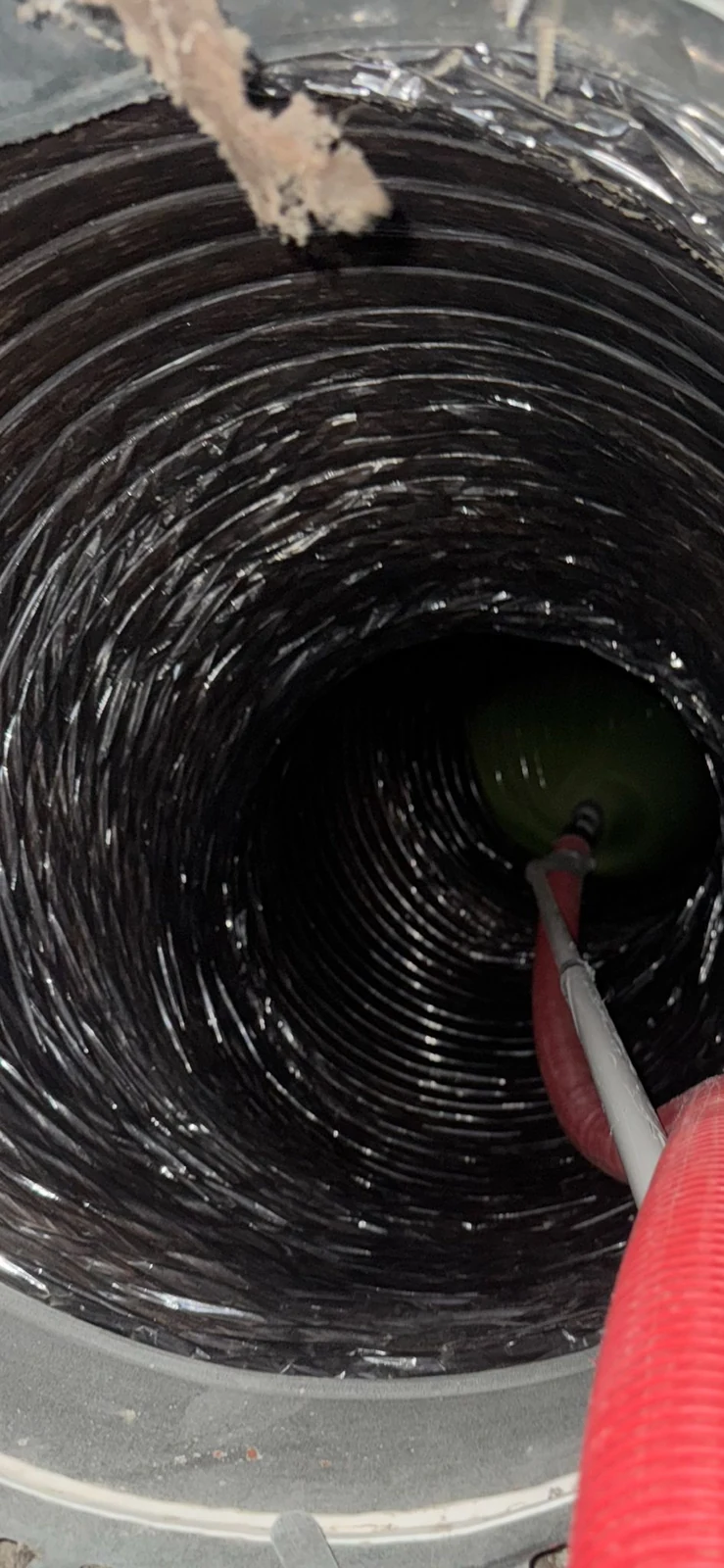
A post-2010 system is usually not dirty in the way people picture. What comes out is the construction phase — drywall fines, sawdust, insulation fiber — that was pulled into open ducts before the house was ever occupied, plus whatever a kinked flex run has been collecting behind the crimp. That is a different cleaning: shorter, more targeted, and far more dependent on the before-and-after photographs, because the difference is not something you can smell.
How do you know cleaning part of the system is enough?
The camera decides, not a hunch. We scope the whole system first; if debris is concentrated in the returns or specific branches, we clean those and document the rest as verified clean.
Why are return ducts dirtier than supply ducts?
Because they run upstream of the filter. Returns pull raw room air — dust, pet hair, fibers, pollen tracked in on shoes — straight into the ductwork before anything filters it.
04Book in Converse
Three fields, and a person calls you back.
Tell us the ZIP and we will tell you what your system likely needs — including, sometimes, that it needs nothing yet. Nothing is charged until you have approved a written quote.
05Questions
Asked in Converse, answered straight.
How do you know cleaning part of the system is enough?
The camera decides, not a hunch. We scope the whole system first; if debris is concentrated in the returns or specific branches, we clean those and document the rest as verified clean. If footage shows buildup everywhere, we'll say a full cleaning is the honest recommendation — with the photos to prove it.
Why are return ducts dirtier than supply ducts?
Because they run upstream of the filter. Returns pull raw room air — dust, pet hair, fibers, pollen tracked in on shoes — straight into the ductwork before anything filters it. Supplies only see air the filter has already scrubbed. That asymmetry is why return-side cleaning is often the smartest partial job.
We had the ducts cleaned and the dust was back in a month. What went wrong?
Usually nothing was cleaned badly. In these plans the house pulls a portion of its air from the attic through boot and penetration leaks, so the supply of new dust never stopped. That is why we scope the return side and the boots before recommending a cleaning. If leakage is the source, sealing it is the work that holds, and cleaning afterward actually stays clean.
The upstairs rooms never cool with the doors shut. Is a duct blocked?
Rarely. It is almost always the missing return path. With one central return downstairs and none in the bedrooms, a closed door traps the supply air with nowhere to go and the room stalls. An undercut door, a transfer grille or a jumper duct fixes it for a fraction of what people expect, and it is worth ruling out before anyone talks about cleaning.
Our house is fifteen years old. Is the original flex still good?
Sometimes yes, sometimes not, and photographs settle it faster than any rule of thumb. What we look for is compressed insulation at every strap, a run that has dropped into a low loop between supports, and a torn liner at the tight bends. A cleaning cannot repair any of those. When we find them we say which sections deserve replacing and which are fine as they are.
Supply & Return Duct Cleaning nearby
Everything we do in ConverseLast reviewed: