
Supply & Return Duct Cleaning in Farmers Branch
Targeted source removal for the runs that actually need it.
01Farmers Branch — the housing record
What Farmers Branch actually has behind its walls.
Before anyone quotes a duct job here, this is the stock they are quoting against. It is public Census data, and it is different in every city we cover.
- Housing units
- 16,754
- Built pre-1980
- 35%
- Built 2000s
- 17%
- Built since 2010
- 35%
- Gas heat
- 39%
- Electric heat
- 59%
- Single-family
- 45%
U.S. Census Bureau, American Community Survey 5-Year Estimates (2023), tables B25034, B25040 and B25024. Percentages are rounded and describe the city, not your house.
What that means for ducts
Retrofit-era ductwork
About 35% of Farmers Branch's homes went up before 1980, which is before central air was designed into a house rather than added to it. Duct runs in that stock were threaded through attics and crawl spaces after the fact, often more than once, and the flex in them has had decades of Texas attic heat. Expect route surprises, expect joints that have worked loose, and expect a system nobody has opened.
That is a reading of the city’s stock, not a diagnosis of your home. Which of it applies to you is exactly what the camera settles — and why we would rather run one than quote from a postcode.
02Working in Farmers Branch
The part that changes from street to street.
Farmers Branch has almost exactly as much housing built before 1980 as it does housing built in the last dozen years, and the two halves have very little in common. The older half is the 1950s and 60s slab stock around Brookhaven and Webb Chapel, where central air was added to houses designed without it. In some of those we still find floor registers fed by supply runs cast below the slab rather than routed overhead, and that is not attic flex and cannot be treated like it. If a below-slab run has taken on moisture, the honest recommendation is to abandon it and go overhead, which is HVAC contractor work, not a cleaning. The newer half of the city is Mercer Crossing, where most units are attached, the equipment is a closet air handler and the entire system can be scoped in one pass. Electric heat is the majority on both sides of that divide, so the coil rather than a burner is where we start.
the Farmers Branch Historical Park
- Brookhaven ·
- Webb Chapel ·
- Mercer Crossing ·
- Valwood
County
Dallas County
Same standard in Farmers Branch as everywhere else.
Source removal to the NADCA ACR standard, a written quote before anything is touched, and camera photographs of your own runs before and after. We are not going to re-argue that on every city page — it is set out once, in full, on the service page.
- Camera confirmation of which runs need work before you approve anything
- Negative-pressure source removal on the affected trunks and branches
- After photos of every cleaned run
- A written note of the runs verified clean and left alone
- From
- $199
- On site
- 2–3 hours
- Scope
- 4 lines
Prices shown are starting estimates and may change with the condition, access, and scope we find on site. Only a written quote from an on-site visit is a price we commit to.
03Supply & Return Duct Cleaning — in this stock
Cleaning a system that was added, not designed in.
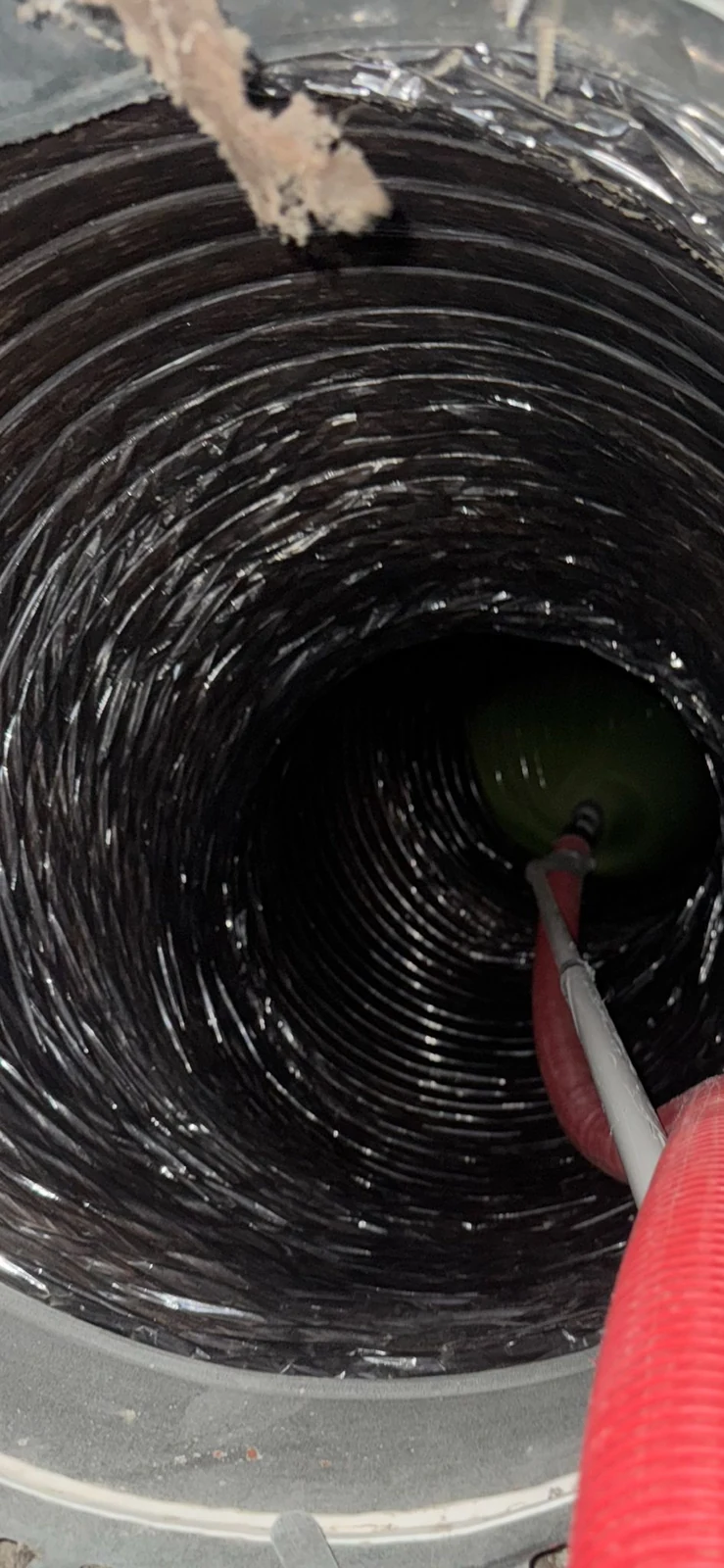
In pre-1980 stock the runs were threaded through the house after the fact — around plaster, through crawl spaces, across attics that were never meant to be conditioned. Two consequences for a cleaning: the route is rarely what the plans suggest, so the system gets mapped on camera before anything is agitated; and joints that have been flexing through forty Texas summers can let go under negative pressure. We would rather find that with a camera and quote the repair than discover it with a vacuum running.
How do you know cleaning part of the system is enough?
The camera decides, not a hunch. We scope the whole system first; if debris is concentrated in the returns or specific branches, we clean those and document the rest as verified clean.
Why are return ducts dirtier than supply ducts?
Because they run upstream of the filter. Returns pull raw room air — dust, pet hair, fibers, pollen tracked in on shoes — straight into the ductwork before anything filters it.
04Book in Farmers Branch
Three fields, and a person calls you back.
Tell us the ZIP and we will tell you what your system likely needs — including, sometimes, that it needs nothing yet. Nothing is charged until you have approved a written quote.
05Questions
Asked in Farmers Branch, answered straight.
How do you know cleaning part of the system is enough?
The camera decides, not a hunch. We scope the whole system first; if debris is concentrated in the returns or specific branches, we clean those and document the rest as verified clean. If footage shows buildup everywhere, we'll say a full cleaning is the honest recommendation — with the photos to prove it.
Why are return ducts dirtier than supply ducts?
Because they run upstream of the filter. Returns pull raw room air — dust, pet hair, fibers, pollen tracked in on shoes — straight into the ductwork before anything filters it. Supplies only see air the filter has already scrubbed. That asymmetry is why return-side cleaning is often the smartest partial job.
Our 1958 house has vents in the floor. What does that tell you?
That the supply side may run below the slab, which changes the whole conversation. Those runs sit in ground contact, and once moisture or soil gets in there is no cleaning that makes them right again. We camera them before saying anything. When the finding is bad we say so plainly, because the correct answer is a new overhead system, not our brush.
We just moved into an apartment at Mercer Crossing. Should we clean the ducts?
Not on a schedule. In a new attached unit the duct is short, the system is young and the useful check is whether the filter fits its frame and whether the return closet is sealed against the chase behind it. Save the money for a better filter, and call us if something actually appears at the registers.
The old part of the house has one return in the hallway and it roars.
A single central return sized for the original equipment is typical in this stock, and every replacement since has moved more air through the same opening. That is what you hear. It also means the system draws harder on every gap it can find. Adding return area does more for comfort and for filtration than cleaning the supply branches would.
Supply & Return Duct Cleaning nearby
- Dallas ·
- Irving ·
- Garland ·
- Mesquite ·
- Richardson ·
- Carrollton ·
- Coppell ·
- Highland Park ·
- University Park ·
- Addison
Last reviewed: