
Supply & Return Duct Cleaning in Heath
Targeted source removal for the runs that actually need it.
01Heath — the housing record
What Heath actually has behind its walls.
Before anyone quotes a duct job here, this is the stock they are quoting against. It is public Census data, and it is different in every city we cover.
- Housing units
- 3,466
- Built pre-1980
- 3%
- Built 2000s
- 46%
- Built since 2010
- 26%
- Gas heat
- 55%
- Electric heat
- 40%
- Single-family
- 97%
U.S. Census Bureau, American Community Survey 5-Year Estimates (2023), tables B25034, B25040 and B25024. Percentages are rounded and describe the city, not your house.
What that means for ducts
Mixed-era stock
Heath splits across build eras — 3% pre-1980, 26% since 2010 — so two houses on the same street can need completely different work. It is the case where guessing from the curb is worst, and where a camera before a quote saves the most money.
That is a reading of the city’s stock, not a diagnosis of your home. Which of it applies to you is exactly what the camera settles — and why we would rather run one than quote from a postcode.
02Working in Heath
The part that changes from street to street.
Heath is almost entirely detached houses and most of them are large, which changes the arithmetic of this work. A big house on the Lake Ray Hubbard side of town usually runs two or three systems rather than one, with long trunk lines reaching wings nobody occupies for weeks at a time. A system serving a guest wing or a room over the garage runs less, dehumidifies less, and leaves damp air sitting in its ducts longer, and that is where we most often find a coil and a supply plenum in worse condition than the rest of the house. Zoning adds its own failures. Dampers that stopped moving years ago hold a branch permanently closed, so whatever settles in it stays. Gas heat is the majority here, which puts the furnace cabinet and the flue connection into the inspection rather than leaving them out. And a house sitting near open water takes in damper air than one a few miles inland, which shows itself at register edges before it shows anywhere else.
the Lake Ray Hubbard shoreline
- The Shores ·
- Stoneleigh on the Lake ·
- Buffalo Creek
County
Rockwall County
Same standard in Heath as everywhere else.
Source removal to the NADCA ACR standard, a written quote before anything is touched, and camera photographs of your own runs before and after. We are not going to re-argue that on every city page — it is set out once, in full, on the service page.
- Camera confirmation of which runs need work before you approve anything
- Negative-pressure source removal on the affected trunks and branches
- After photos of every cleaned run
- A written note of the runs verified clean and left alone
- From
- $199
- On site
- 2–3 hours
- Scope
- 4 lines
Prices shown are starting estimates and may change with the condition, access, and scope we find on site. Only a written quote from an on-site visit is a price we commit to.
03Supply & Return Duct Cleaning — in this stock
Cleaning where the street does not tell you the answer.
This is the stock where two houses forty feet apart genuinely need different work — one built when ducts were retrofitted, one built when they were designed in. Quoting a cleaning from an address here is guessing. It is the single strongest case for putting a camera in first and letting the footage decide whether you are buying a full system or two runs.
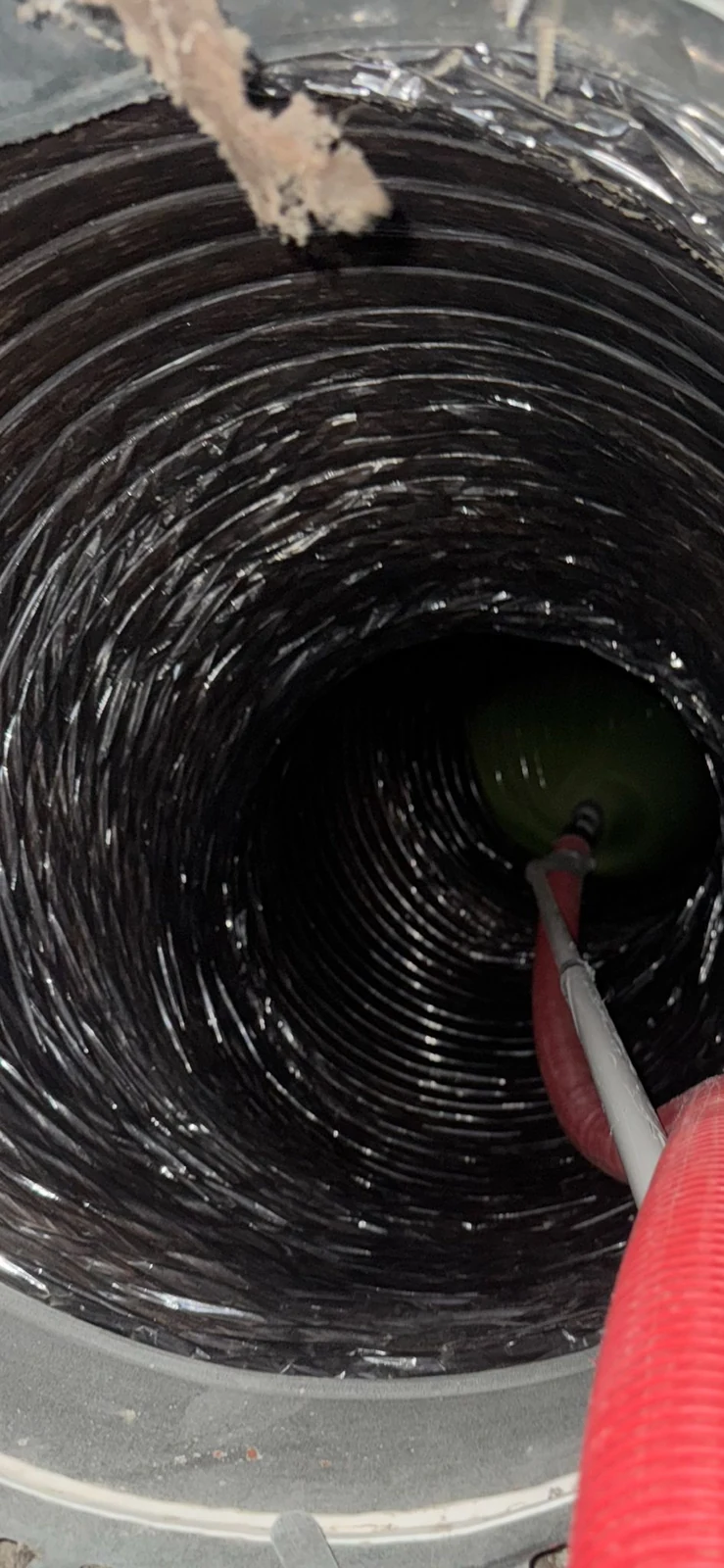
How do you know cleaning part of the system is enough?
The camera decides, not a hunch. We scope the whole system first; if debris is concentrated in the returns or specific branches, we clean those and document the rest as verified clean.
Why are return ducts dirtier than supply ducts?
Because they run upstream of the filter. Returns pull raw room air — dust, pet hair, fibers, pollen tracked in on shoes — straight into the ductwork before anything filters it.
04Book in Heath
Three fields, and a person calls you back.
Tell us the ZIP and we will tell you what your system likely needs — including, sometimes, that it needs nothing yet. Nothing is charged until you have approved a written quote.
05Questions
Asked in Heath, answered straight.
How do you know cleaning part of the system is enough?
The camera decides, not a hunch. We scope the whole system first; if debris is concentrated in the returns or specific branches, we clean those and document the rest as verified clean. If footage shows buildup everywhere, we'll say a full cleaning is the honest recommendation — with the photos to prove it.
Why are return ducts dirtier than supply ducts?
Because they run upstream of the filter. Returns pull raw room air — dust, pet hair, fibers, pollen tracked in on shoes — straight into the ductwork before anything filters it. Supplies only see air the filter has already scrubbed. That asymmetry is why return-side cleaning is often the smartest partial job.
We have three systems. Do they all need the same attention?
Almost never. The one carrying the main living areas usually looks the best, because it runs constantly and stays dry. The unit serving a guest wing or an upstairs bonus room is the one we find with a dirty coil and a stale plenum, since it cycles rarely and the air in those runs sits. We inspect and price them separately for exactly that reason.
Part of the house is closed off most of the year. Is that a problem for the ducts?
It can be, and it is one of the most common findings we have in Heath. A closed zone means little airflow and no dehumidification in that part of the system, and if the zone damper has seized shut, which happens after enough years, that branch is dead air. We confirm every damper still moves before assuming the duct is the issue.
Our guest wing smells stale within a day of opening it up. What is that?
Air that has been standing in warm ducts, usually with a coil upstream that never dried out properly. It is not proof of contamination, and we would rather look than sell a cleaning on the strength of a smell. If the coil and plenum photograph clean, the answer is running that zone more often, not treating it.
Last reviewed: