
Register Add or Relocate in New Braunfels
For the room that never cools — measured first, cut second.
01New Braunfels — the housing record
What New Braunfels actually has behind its walls.
Before anyone quotes a duct job here, this is the stock they are quoting against. It is public Census data, and it is different in every city we cover.
- Housing units
- 41,814
- Built pre-1980
- 13%
- Built 2000s
- 30%
- Built since 2010
- 39%
- Gas heat
- 19%
- Electric heat
- 79%
- Single-family
- 69%
U.S. Census Bureau, American Community Survey 5-Year Estimates (2023), tables B25034, B25040 and B25024. Percentages are rounded and describe the city, not your house.
What that means for ducts
New-build ductwork
Roughly 39% of New Braunfels's homes were built since 2010. New does not mean clean: the commonest thing we pull out of a five-year-old system is the construction phase itself — drywall fines, sawdust, insulation fiber — plus builder-grade flex that was kinked or crushed on the day and has been throttling that run ever since. Photographs matter more here, not less.
That is a reading of the city’s stock, not a diagnosis of your home. Which of it applies to you is exactly what the camera settles — and why we would rather run one than quote from a postcode.
02Working in New Braunfels
The part that changes from street to street.
New Braunfels has grown quickly, with a large share of its homes going up since 2010, but it also keeps a meaningful stock of manufactured housing and a river-corridor geography that changes the work. Manufactured homes have no attic duct at all; the runs sit in a belly board beneath the floor inside a moisture barrier, and the first thing to establish is whether that wrap is torn and whether anything has moved in. That is a repair question before it is ever a cleaning question. Along the Comal and the Guadalupe, lots hold humidity longer, and cool supply surfaces sitting in damp crawl and slab-edge air will condense and stain. Heating here is nearly all electric. A vent pipe and a heat exchanger simply never enter the conversation. What does is the coil where moisture collects, and the strip heaters that scorch settled dust every first cold morning.
Gruene Hall
- Gruene ·
- Historic Downtown ·
- Vintage Oaks ·
- Veramendi ·
- River Chase
County
Comal County
Same standard in New Braunfels as everywhere else.
Source removal to the NADCA ACR standard, a written quote before anything is touched, and camera photographs of your own runs before and after. We are not going to re-argue that on every city page — it is set out once, in full, on the service page.
- Static pressure and delivered airflow measured before anything is cut
- New supply run, new return, or relocated register sized to the room
- Takeoff sealed with mastic, run supported and insulated
- Airflow re-measured at the new register and at the rooms it draws from
- A straight answer if your system has no capacity left to give
- From
- $449
- On site
- 3–5 hours
- Scope
- 5 lines
Prices shown are starting estimates and may change with the condition, access, and scope we find on site. Only a written quote from an on-site visit is a price we commit to.
03Register Add or Relocate — in this stock
Leakage in a house that should not have any.
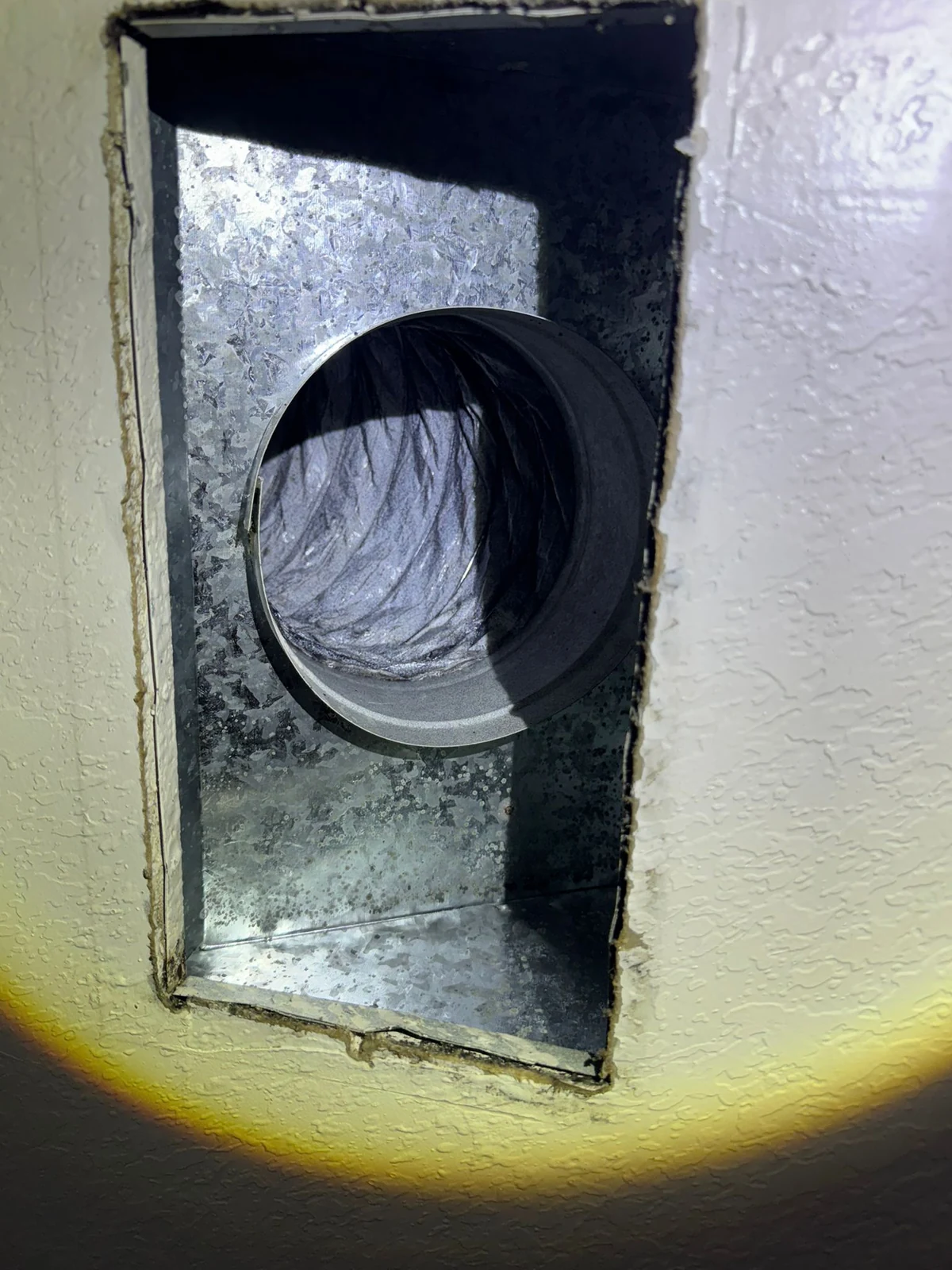
New does not mean sealed. Production-built systems routinely have unsealed takeoffs, boots that were never mastic-sealed to the drywall, and flex that was pulled tight over a corner. It is quick, cheap work on a young house, and doing it before the first cleaning means you are not paying to clean air that is escaping anyway.
Ask us anything about this on the phone — a person answers during opening hours.
All register add or relocate questions04Book in New Braunfels
Three fields, and a person calls you back.
Tell us the ZIP and we will tell you what your system likely needs — including, sometimes, that it needs nothing yet. Nothing is charged until you have approved a written quote.
05Questions
Asked in New Braunfels, answered straight.
We live in a manufactured home outside town. Is duct cleaning the same process?
No, and it matters here because manufactured housing is a real part of the New Braunfels stock. Those ducts run in a belly board under the floor inside a moisture barrier. Torn belly wrap and rodent entry are the usual findings, and both are repairs that come before any cleaning is worth doing.
Our house is close to the Comal. Does river humidity reach the ductwork?
It can. River-corridor lots hold humidity longer, and crawl or slab-edge moisture migrates toward cool supply surfaces. We check for condensation staining at boots and register edges. When we find it, the durable fix is insulation and sealing at that boot rather than a cleaning you would repeat every year.
Nearly everything here is electric heat. What does that change?
It takes combustion out of the picture. Without a burner there is nothing to vent and nothing to crack, which removes two standard inspection items. Attention moves to the indoor coil where moisture condenses, and to the strip heaters that scorch settled dust on the first cold morning. That burning smell people report is almost always dust, not equipment failure.
Last reviewed: