
Camera Duct Inspection & Air-Quality Assessment in Forney
See inside your ducts before you spend a dollar on cleaning.
01Forney — the housing record
What Forney actually has behind its walls.
Before anyone quotes a duct job here, this is the stock they are quoting against. It is public Census data, and it is different in every city we cover.
- Housing units
- 9,894
- Built pre-1980
- 6%
- Built 2000s
- 36%
- Built since 2010
- 47%
- Gas heat
- 44%
- Electric heat
- 54%
- Single-family
- 80%
U.S. Census Bureau, American Community Survey 5-Year Estimates (2023), tables B25034, B25040 and B25024. Percentages are rounded and describe the city, not your house.
What that means for ducts
New-build ductwork
Roughly 47% of Forney's homes were built since 2010. New does not mean clean: the commonest thing we pull out of a five-year-old system is the construction phase itself — drywall fines, sawdust, insulation fiber — plus builder-grade flex that was kinked or crushed on the day and has been throttling that run ever since. Photographs matter more here, not less.
That is a reading of the city’s stock, not a diagnosis of your home. Which of it applies to you is exactly what the camera settles — and why we would rather run one than quote from a postcode.
02Working in Forney
The part that changes from street to street.
Forney has been a construction site for twenty years and still is. Nearly half the housing went up after 2010 and most of the rest through the 2000s, which puts an unusual number of homes at the same point in their life at the same time. The builder flex is now eight to fifteen years old, past the age where installation shortcuts stay invisible. A run left long and looped over a truss has settled into a low spot. Straps have compressed the insulation flat where they cross. Mastic at a couple of boots has dried and let go. None of that is dirt, none of it is fixed by a brush, and all of it reads to the homeowner as a room that will not cool. The other thing about living in a city that is still building is that the dust is outdoors. When a new phase opens behind your fence, what gets into the system comes through return leaks and the attic rather than the front door. Heating splits close to evenly here, so which equipment you have decides the second half of the inspection.
the Spellman Museum of Forney History
Same standard in Forney as everywhere else.
Source removal to the NADCA ACR standard, a written quote before anything is touched, and camera photographs of your own runs before and after. We are not going to re-argue that on every city page — it is set out once, in full, on the service page.
- Photo documentation of every accessible supply and return run
- Written condition report with dust-load and moisture notes
- A clean-now, clean-partial, or not-yet verdict measured against EPA guidance
- Filtration and next-steps advice included at no extra charge
- From
- $99
- On site
- 60–90 minutes
- Scope
- 4 lines
Prices shown are starting estimates and may change with the condition, access, and scope we find on site. Only a written quote from an on-site visit is a price we commit to.
03Camera Duct Inspection & Air-Quality Assessment — in this stock
What a camera finds in new-build stock.
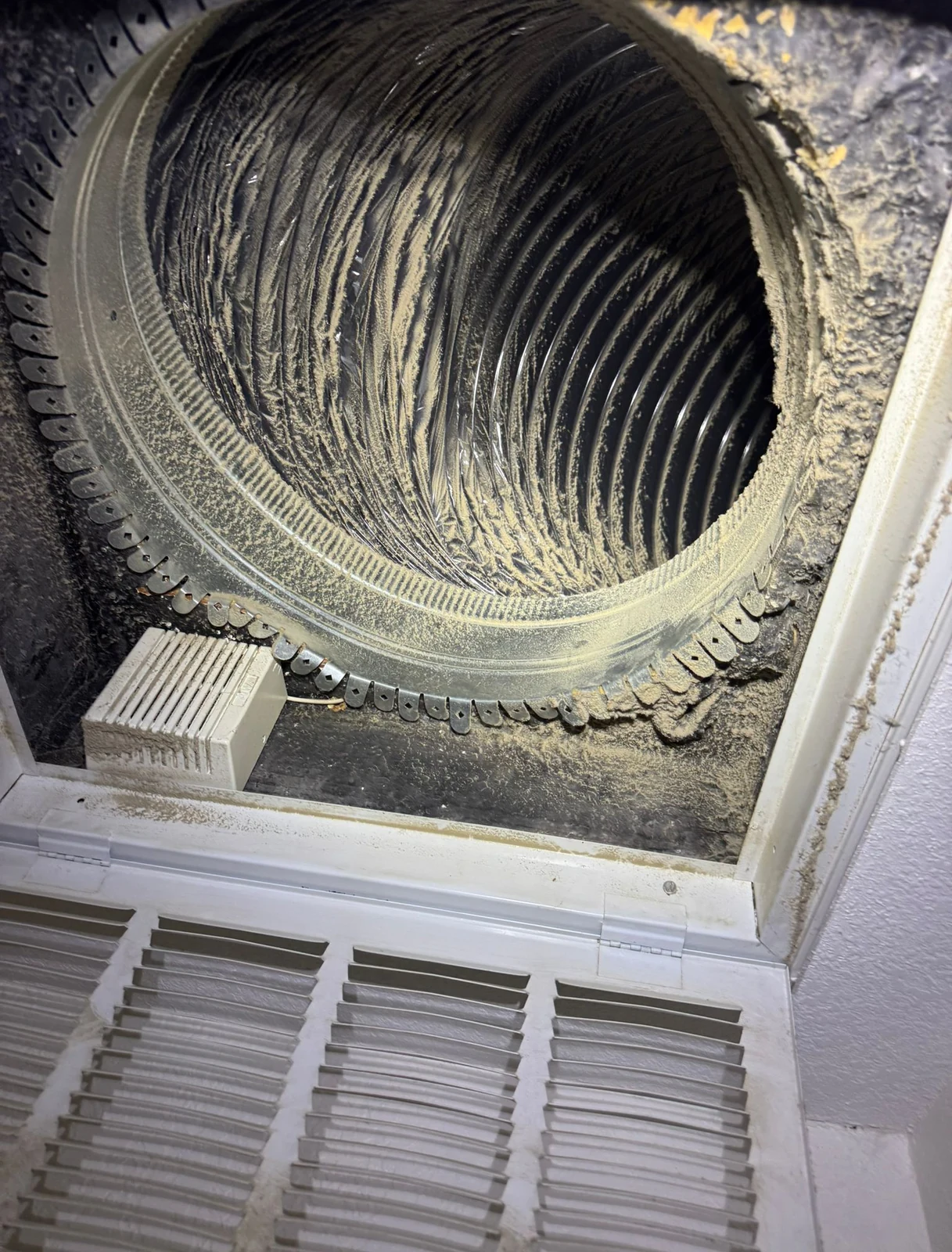
New construction inspections turn up a specific short list: crushed or kinked flex from the install day, boots that were never sealed to the drywall, and a system still loaded with build debris. None of it is visible from a register, all of it is cheap to fix early, and a fair number of these inspections end with "leave it, re-check in a few years" — which is a legitimate outcome we would rather sell you than a cleaning you do not need.
Is the $99 inspection just a setup for selling me a cleaning?
No — it's priced to stand on its own, and a meaningful share of inspections end with 'not yet.' You get photos, a written report, and a verdict measured against EPA's conditions. Plenty of customers use it to evaluate another company's quote, which we consider a perfectly good outcome..
What does the camera actually show?
Dust depth, debris, moisture staining, growth-suspect areas, torn liner, and crushed or disconnected runs — through every accessible supply and return plus both plenums. You watch the screen live as we go, so by the time the report arrives, you've already seen everything in it yourself..
04Book in Forney
Three fields, and a person calls you back.
Tell us the ZIP and we will tell you what your system likely needs — including, sometimes, that it needs nothing yet. Nothing is charged until you have approved a written quote.
05Questions
Asked in Forney, answered straight.
Is the $99 inspection just a setup for selling me a cleaning?
No — it's priced to stand on its own, and a meaningful share of inspections end with 'not yet.' You get photos, a written report, and a verdict measured against EPA's conditions. Plenty of customers use it to evaluate another company's quote, which we consider a perfectly good outcome.
What does the camera actually show?
Dust depth, debris, moisture staining, growth-suspect areas, torn liner, and crushed or disconnected runs — through every accessible supply and return plus both plenums. You watch the screen live as we go, so by the time the report arrives, you've already seen everything in it yourself.
One bedroom never cools properly. Is a duct cleaning going to help?
Probably not. In Forney houses of this age the usual cause is the flex itself: a run sagging into a low spot, a kink where it passes a truss, or a boot that separated from the ceiling. We put a camera on that branch and measure what actually leaves the register. If it is mechanical, cleaning changes nothing and we will say so.
They are building the next section behind us. Should we wait until it is finished?
For a cleaning, yes. Clean while heavy construction runs next door and you will pay to do it twice. In the meantime the useful work is sealing the return side and changing filters more often than the label suggests. Once the last slab is poured, a camera look tells you whether anything got in.
Our house is twelve years old. Is that when this normally becomes necessary?
It is when it becomes worth looking, which is not the same thing. Ten to fifteen years is when builder flex in a hot attic starts showing compression, dried mastic and separated boots. Whether that means cleaning, repair or nothing depends on the footage. Plenty of twelve-year-old Forney systems need one section fixed and nothing else.
Last reviewed: