
Camera Duct Inspection & Air-Quality Assessment in Terrell
See inside your ducts before you spend a dollar on cleaning.
01Terrell — the housing record
What Terrell actually has behind its walls.
Before anyone quotes a duct job here, this is the stock they are quoting against. It is public Census data, and it is different in every city we cover.
- Housing units
- 6,331
- Built pre-1980
- 31%
- Built 2000s
- 33%
- Built since 2010
- 8%
- Gas heat
- 33%
- Electric heat
- 65%
- Single-family
- 70%
U.S. Census Bureau, American Community Survey 5-Year Estimates (2023), tables B25034, B25040 and B25024. Percentages are rounded and describe the city, not your house.
What that means for ducts
Retrofit-era ductwork
About 31% of Terrell's homes went up before 1980, which is before central air was designed into a house rather than added to it. Duct runs in that stock were threaded through attics and crawl spaces after the fact, often more than once, and the flex in them has had decades of Texas attic heat. Expect route surprises, expect joints that have worked loose, and expect a system nobody has opened.
That is a reading of the city’s stock, not a diagnosis of your home. Which of it applies to you is exactly what the camera settles — and why we would rather run one than quote from a postcode.
02Working in Terrell
The part that changes from street to street.
Close to a third of Terrell's housing is something other than a detached house, and a good part of that is rented. It matters more than it sounds. A duplex or a small apartment block turns over often, the filter gets changed by whoever remembers, and the system reaches us with no history at all: nobody can say when the coil was last opened, how long the return has whistled, or what the last tenant's animals left behind. So we document what is actually in the system here rather than assume a pattern from the year built. On the owner-occupied side, roughly a third of the town predates 1980, and those houses tend to run an original metal trunk with later work grafted onto it. Most of Terrell heats with electricity, so there is no combustion side to inspect and the coil and drain pan are where genuine air-quality problems start. Very little has been built here since 2010, which means age is the one thing nearly every system in town has in common.
the No. 1 British Flying Training School Museum
Same standard in Terrell as everywhere else.
Source removal to the NADCA ACR standard, a written quote before anything is touched, and camera photographs of your own runs before and after. We are not going to re-argue that on every city page — it is set out once, in full, on the service page.
- Photo documentation of every accessible supply and return run
- Written condition report with dust-load and moisture notes
- A clean-now, clean-partial, or not-yet verdict measured against EPA guidance
- Filtration and next-steps advice included at no extra charge
- From
- $99
- On site
- 60–90 minutes
- Scope
- 4 lines
Prices shown are starting estimates and may change with the condition, access, and scope we find on site. Only a written quote from an on-site visit is a price we commit to.
03Camera Duct Inspection & Air-Quality Assessment — in this stock
What a camera finds in older stock.
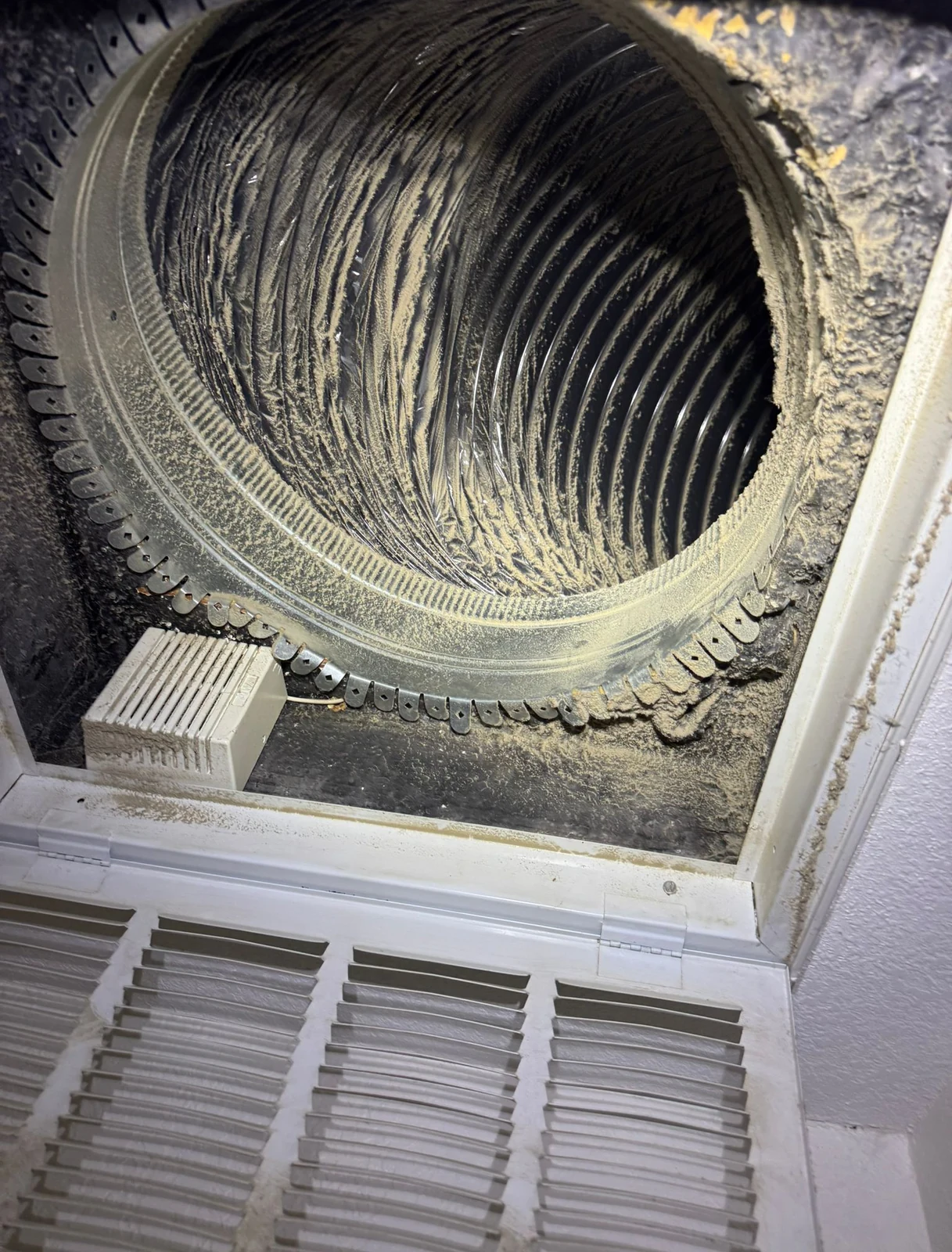
In a city this age the inspection is usually not answering "is it dusty". It is answering whether a run has separated in the attic, whether a previous retrofit left an unsealed takeoff pulling unconditioned air, and whether there is moisture history in the plenum. Those are findings that change what you should spend money on — and several of them mean a cleaning is the wrong purchase until the repair is done.
Is the $99 inspection just a setup for selling me a cleaning?
No — it's priced to stand on its own, and a meaningful share of inspections end with 'not yet.' You get photos, a written report, and a verdict measured against EPA's conditions. Plenty of customers use it to evaluate another company's quote, which we consider a perfectly good outcome..
What does the camera actually show?
Dust depth, debris, moisture staining, growth-suspect areas, torn liner, and crushed or disconnected runs — through every accessible supply and return plus both plenums. You watch the screen live as we go, so by the time the report arrives, you've already seen everything in it yourself..
04Book in Terrell
Three fields, and a person calls you back.
Tell us the ZIP and we will tell you what your system likely needs — including, sometimes, that it needs nothing yet. Nothing is charged until you have approved a written quote.
05Questions
Asked in Terrell, answered straight.
Is the $99 inspection just a setup for selling me a cleaning?
No — it's priced to stand on its own, and a meaningful share of inspections end with 'not yet.' You get photos, a written report, and a verdict measured against EPA's conditions. Plenty of customers use it to evaluate another company's quote, which we consider a perfectly good outcome.
What does the camera actually show?
Dust depth, debris, moisture staining, growth-suspect areas, torn liner, and crushed or disconnected runs — through every accessible supply and return plus both plenums. You watch the screen live as we go, so by the time the report arrives, you've already seen everything in it yourself.
I own several rental properties in Terrell. How should I handle this across them?
Inspect at turnover. It is the only moment the unit is empty, and a dated set of photos protects you from being blamed later for the last tenant's smoke or pets. Several addresses in one visit costs less per unit than treating each as its own job, and you end up holding a condition record instead of a guess.
The house we bought smells like the previous owners' cats. Will cleaning the ducts fix it?
Partly, and we will not promise more than that. Odor from years of animals lives in carpet, pad, drywall and attic insulation as much as in the duct. Cleaning the system and treating the coil removes the reservoir that keeps recirculating it. If the smell survives that, what is left is in the house, not the ductwork.
We bought a place that sat empty for most of a year. Anything specific to check?
Yes. A system that idled through a Texas summer has had a wet coil and a still drain pan with nothing moving through it, which is the condition that grows things. We open the cabinet, check the pan and the trap, and run it long enough to see whether the drain actually clears before discussing the duct at all.
Last reviewed: