
New-Construction Duct Dust-Out in Trophy Club
Construction debris out of the ducts before you move in.
01Trophy Club — the housing record
What Trophy Club actually has behind its walls.
Before anyone quotes a duct job here, this is the stock they are quoting against. It is public Census data, and it is different in every city we cover.
- Housing units
- 4,923
- Built pre-1980
- 4%
- Built 2000s
- 36%
- Built since 2010
- 32%
- Gas heat
- 56%
- Electric heat
- 39%
- Single-family
- 94%
U.S. Census Bureau, American Community Survey 5-Year Estimates (2023), tables B25034, B25040 and B25024. Percentages are rounded and describe the city, not your house.
What that means for ducts
New-build ductwork
Roughly 32% of Trophy Club's homes were built since 2010. New does not mean clean: the commonest thing we pull out of a five-year-old system is the construction phase itself — drywall fines, sawdust, insulation fiber — plus builder-grade flex that was kinked or crushed on the day and has been throttling that run ever since. Photographs matter more here, not less.
That is a reading of the city’s stock, not a diagnosis of your home. Which of it applies to you is exactly what the camera settles — and why we would rather run one than quote from a postcode.
02Working in Trophy Club
The part that changes from street to street.
Trophy Club is detached houses almost to the last address, and they came in two waves: the streets laid out around the golf course in the 2000s and a newer stretch built since 2010. The newer wave is where the unusual work is. Those plans often use one air handler with motorized zone dampers rather than two separate systems, so when a zone closes the same blower pushes the same volume of air through half the duct. Static pressure climbs, the bypass meant to relieve it was either never installed or has been wired shut, and the filter bows in a frame that stops sealing under that pressure. Air then slips past the edge of the filter carrying everything it was supposed to catch. In the older half of town the systems are conventional and roughly two decades in. Gas furnaces are the majority either way, so a burner cabinet is part of the picture along with the duct.
Trophy Club Country Club
- Eagles Ridge ·
- The Highlands ·
- Lake Cities ·
- Trophy Wood
County
Tarrant County
Same standard in Trophy Club as everywhere else.
Source removal to the NADCA ACR standard, a written quote before anything is touched, and camera photographs of your own runs before and after. We are not going to re-argue that on every city page — it is set out once, in full, on the service page.
- Full-system source removal tuned to drywall and construction fines
- Both plenums cleared and a fresh filter installed
- Camera verification photos of the finished runs
- Builder- and closing-ready completion report
- From
- $449
- On site
- 3–5 hours
- Scope
- 4 lines
Prices shown are starting estimates and may change with the condition, access, and scope we find on site. Only a written quote from an on-site visit is a price we commit to.
03New-Construction Duct Dust-Out — in this stock
The build-out clean nobody did.
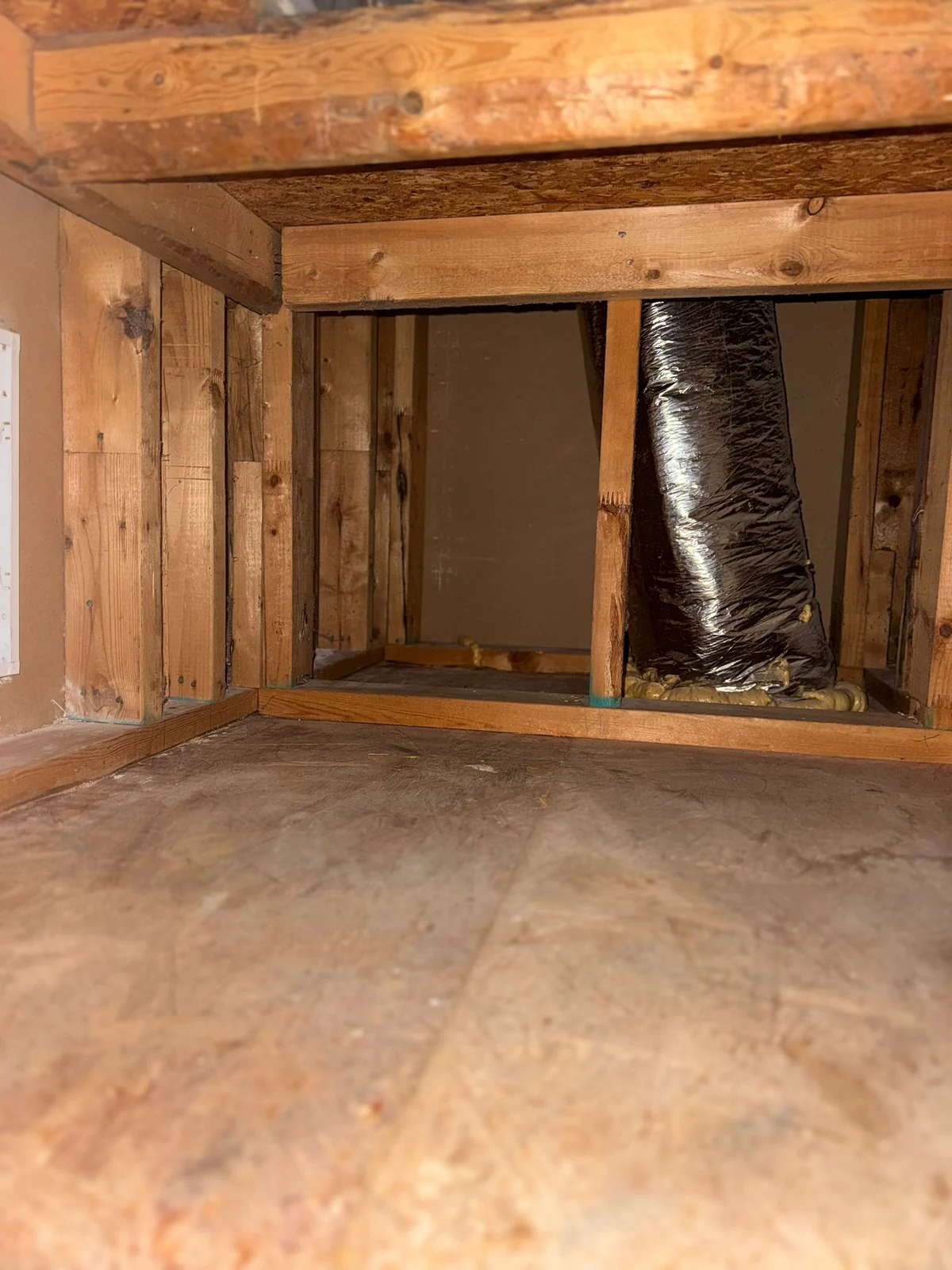
In new-construction cities this is the commonest job we run, and the commonest thing homeowners do not know they need. Ducts sit open through drywall, sanding and flooring; the system then runs that straight into a house on day one. A dust-out is cheap, fast, and the photographs make it obvious it was needed.
Shouldn't my builder have cleaned the ducts already?
Sometimes it's in the contract; often it's skipped or done superficially in the rush to closing. Ask your builder for documentation — an invoice and photos.
When is the ideal time to schedule a dust-out?
After the final sanding and paint work, before move-in — that's when the ducts have collected everything they're going to collect and your belongings aren't in the way. Already moved in? Still absolutely worth doing; the work is identical, we just add drop cloths and a little more care around furniture..
04Book in Trophy Club
Three fields, and a person calls you back.
Tell us the ZIP and we will tell you what your system likely needs — including, sometimes, that it needs nothing yet. Nothing is charged until you have approved a written quote.
05Questions
Asked in Trophy Club, answered straight.
Shouldn't my builder have cleaned the ducts already?
Sometimes it's in the contract; often it's skipped or done superficially in the rush to closing. Ask your builder for documentation — an invoice and photos. If they can't produce it, our camera answers the question in an hour, and the pre-clean photos give you standing to raise it before your warranty window closes.
When is the ideal time to schedule a dust-out?
After the final sanding and paint work, before move-in — that's when the ducts have collected everything they're going to collect and your belongings aren't in the way. Already moved in? Still absolutely worth doing; the work is identical, we just add drop cloths and a little more care around furniture.
The registers whistle when only the upstairs zone is calling. Is something blocked?
More likely the opposite of blocked. In a zoned single-system house, closing one zone forces the full airflow through the remaining duct, and the whistle is the sound of pressure with nowhere to go. We take static pressure readings with the zones open and again with one closed. If the numbers jump, the answer is a damper or bypass adjustment, not a cleaning.
There are two thermostats but only one filter. Is that correct?
In a zoned system, yes, one air handler means one filter, and it works harder than a filter in a two-system house because it never gets a break. What matters is the frame. We check whether the filter seats tightly and whether the door or track seals, because a zoned system spends much of its life at pressures that will find any gap.
Our house is ten years old. Is there anything to do yet?
Often not, and we would rather look and tell you so. In the post-2010 half of Trophy Club the duct interiors are usually in good shape, and the findings tend to be mechanical: a damper stuck part open, a boot never sealed at the ceiling, a coil that has never been opened. We photograph all of it and let you decide what is worth acting on.
New-Construction Duct Dust-Out nearby
- Fort Worth ·
- Arlington ·
- Grand Prairie ·
- Grapevine ·
- Southlake ·
- Colleyville ·
- Keller ·
- Westlake ·
- Haslet ·
- North Richland Hills
Last reviewed: