
Duct Odor Investigation in Lakeway
Trace musty, stale, or animal odors to their real source.
01Lakeway — the housing record
What Lakeway actually has behind its walls.
Before anyone quotes a duct job here, this is the stock they are quoting against. It is public Census data, and it is different in every city we cover.
- Housing units
- 8,875
- Built pre-1980
- 3%
- Built 2000s
- 36%
- Built since 2010
- 35%
- Gas heat
- 26%
- Electric heat
- 63%
- Single-family
- 80%
U.S. Census Bureau, American Community Survey 5-Year Estimates (2023), tables B25034, B25040 and B25024. Percentages are rounded and describe the city, not your house.
What that means for ducts
New-build ductwork
Roughly 35% of Lakeway's homes were built since 2010. New does not mean clean: the commonest thing we pull out of a five-year-old system is the construction phase itself — drywall fines, sawdust, insulation fiber — plus builder-grade flex that was kinked or crushed on the day and has been throttling that run ever since. Photographs matter more here, not less.
That is a reading of the city’s stock, not a diagnosis of your home. Which of it applies to you is exactly what the camera settles — and why we would rather run one than quote from a postcode.
02Working in Lakeway
The part that changes from street to street.
Lakeway houses are large and they are cut into a hillside, and both facts show up in the mechanical layout rather than in the age of the duct. Most homes here are recent enough that nothing has accumulated from decades of use. What they have instead is two or three separate systems, split by floor or by wing and often tied to zone dampers and a control board, and that changes what an honest quote even looks like. A single price to clean a house means very little on this side of the lake. The number that matters is per system, and in many of these homes only one of them is doing real work. The upper zone runs hard all summer while a lower level built into the slope stays cool, so its system barely cycles, never dehumidifies, and grows things on a coil that is wet more often than it is used. Heat is electric in most of the city, so we are looking at coils and drain pans instead of burners and flues.
Lakeway Marina
- Rough Hollow ·
- Flintrock Falls ·
- The Hills ·
- Lakeway Highlands
County
Travis County
Same standard in Lakeway as everywhere else.
Source removal to the NADCA ACR standard, a written quote before anything is touched, and camera photographs of your own runs before and after. We are not going to re-argue that on every city page — it is set out once, in full, on the service page.
- Full camera pass of accessible runs and both plenums
- Moisture and animal-intrusion check with photos
- The source identified — or your ductwork ruled out — in writing
- A firm-priced fix recommendation, ours or another trade's
- From
- $99
- On site
- 60–120 minutes
- Scope
- 4 lines
Prices shown are starting estimates and may change with the condition, access, and scope we find on site. Only a written quote from an on-site visit is a price we commit to.
03Duct Odor Investigation — in this stock
What a camera finds in new-build stock.
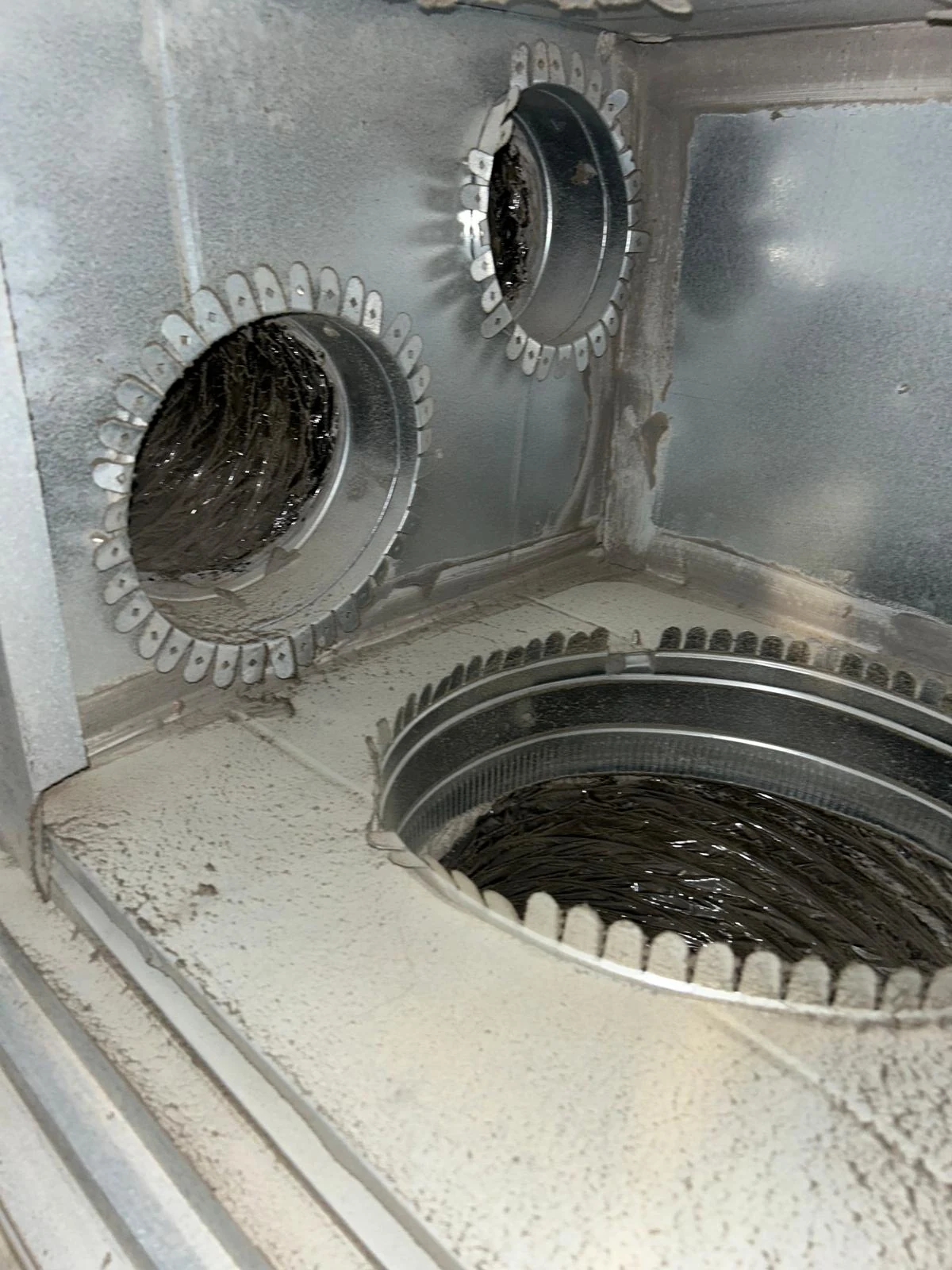
New construction inspections turn up a specific short list: crushed or kinked flex from the install day, boots that were never sealed to the drywall, and a system still loaded with build debris. None of it is visible from a register, all of it is cheap to fix early, and a fair number of these inspections end with "leave it, re-check in a few years" — which is a legitimate outcome we would rather sell you than a cleaning you do not need.
What if the smell turns out not to be the ducts?
Then that's exactly what we tell you, in writing, with the footage that rules the ductwork out — plus our best read on where to look next, whether that's plumbing, the attic itself, or HVAC equipment. You've spent $99 to eliminate the most complicated suspect.
Can you get rid of a dead-animal smell in the ducts?
Yes — locate it on camera, remove it, source-clean the affected run, and where indicated apply an EPA-registered treatment. One honest caveat: after removal, residual odor takes some days to fully dissipate as the system airs out.
04Book in Lakeway
Three fields, and a person calls you back.
Tell us the ZIP and we will tell you what your system likely needs — including, sometimes, that it needs nothing yet. Nothing is charged until you have approved a written quote.
05Questions
Asked in Lakeway, answered straight.
What if the smell turns out not to be the ducts?
Then that's exactly what we tell you, in writing, with the footage that rules the ductwork out — plus our best read on where to look next, whether that's plumbing, the attic itself, or HVAC equipment. You've spent $99 to eliminate the most complicated suspect. We'd rather be right than busy.
Can you get rid of a dead-animal smell in the ducts?
Yes — locate it on camera, remove it, source-clean the affected run, and where indicated apply an EPA-registered treatment. One honest caveat: after removal, residual odor takes some days to fully dissipate as the system airs out. Anyone promising instant scentlessness is overselling; we'll give you the realistic timeline.
Why do you quote per system instead of per house?
Because a house here can hold three of them and their condition is rarely the same. Quoting by the address either overcharges you for systems that are already clean or quietly leaves one out. We scope each unit, tell you which ones need work, and price only those. Two clean systems and one that needs attention is a common outcome in this city.
The lower level smells musty and it is the coolest part of the house.
That combination is common on these hillside plans and it is a runtime problem rather than a dirt problem. A system serving a level built into the slope satisfies the thermostat in minutes and shuts off, so it never runs long enough to remove moisture. Cleaning the duct will not change the humidity. Dehumidification, or a change in how that zone is controlled, will.
We have zone dampers. Do they matter for this?
Enough that we check them before anything else. A damper stuck part closed, or a bypass duct dumping supply straight back into the return, reads from inside the house exactly like a blocked branch. It is worth knowing that a control board is the cause before paying someone to brush a duct that was never obstructed in the first place.
Last reviewed: