
Supply & Return Duct Cleaning in Houston
Targeted source removal for the runs that actually need it.
01Houston — the housing record
What Houston actually has behind its walls.
Before anyone quotes a duct job here, this is the stock they are quoting against. It is public Census data, and it is different in every city we cover.
- Housing units
- 1,023,112
- Built pre-1980
- 29%
- Built 2000s
- 22%
- Built since 2010
- 15%
- Gas heat
- 33%
- Electric heat
- 65%
- Single-family
- 43%
U.S. Census Bureau, American Community Survey 5-Year Estimates (2023), tables B25034, B25040 and B25024. Percentages are rounded and describe the city, not your house.
What that means for ducts
Mixed-era stock
Houston splits across build eras — 29% pre-1980, 15% since 2010 — so two houses on the same street can need completely different work. It is the case where guessing from the curb is worst, and where a camera before a quote saves the most money. Under half the units here are single-family, so a fair number of systems are shared or stacked, and access is the first thing we check.
That is a reading of the city’s stock, not a diagnosis of your home. Which of it applies to you is exactly what the camera settles — and why we would rather run one than quote from a postcode.
02Working in Houston
The part that changes from street to street.
Houston's duct problems are mostly moisture problems wearing a disguise. Dew points sit in the seventies for months, and a system that cools the house quickly then shuts off never runs long enough to pull that moisture out, so the coil and the first stretch of supply duct stay damp between cycles. That, far more than dust, is what makes a Houston house smell musty in August, and cleaning a system that keeps re-wetting itself buys a few weeks at most. The city's housing also skews away from detached single-family: most units here are apartments, condos or attached homes with a closet air handler and short runs, where filter fit and condensate drainage matter more than duct length ever will. And in a city with Houston's flood history, anything that has been submerged should be replaced rather than cleaned. That is the more expensive answer and it is still the correct one.
Space Center Houston
- The Heights ·
- River Oaks ·
- Montrose ·
- Memorial ·
- Bellaire ·
- Midtown ·
- Galleria/Uptown ·
- West University
County
Harris County
Same standard in Houston as everywhere else.
Source removal to the NADCA ACR standard, a written quote before anything is touched, and camera photographs of your own runs before and after. We are not going to re-argue that on every city page — it is set out once, in full, on the service page.
- Camera confirmation of which runs need work before you approve anything
- Negative-pressure source removal on the affected trunks and branches
- After photos of every cleaned run
- A written note of the runs verified clean and left alone
- From
- $199
- On site
- 2–3 hours
- Scope
- 4 lines
Prices shown are starting estimates and may change with the condition, access, and scope we find on site. Only a written quote from an on-site visit is a price we commit to.
03Supply & Return Duct Cleaning — in this stock
Cleaning where the street does not tell you the answer.
This is the stock where two houses forty feet apart genuinely need different work — one built when ducts were retrofitted, one built when they were designed in. Quoting a cleaning from an address here is guessing. It is the single strongest case for putting a camera in first and letting the footage decide whether you are buying a full system or two runs.
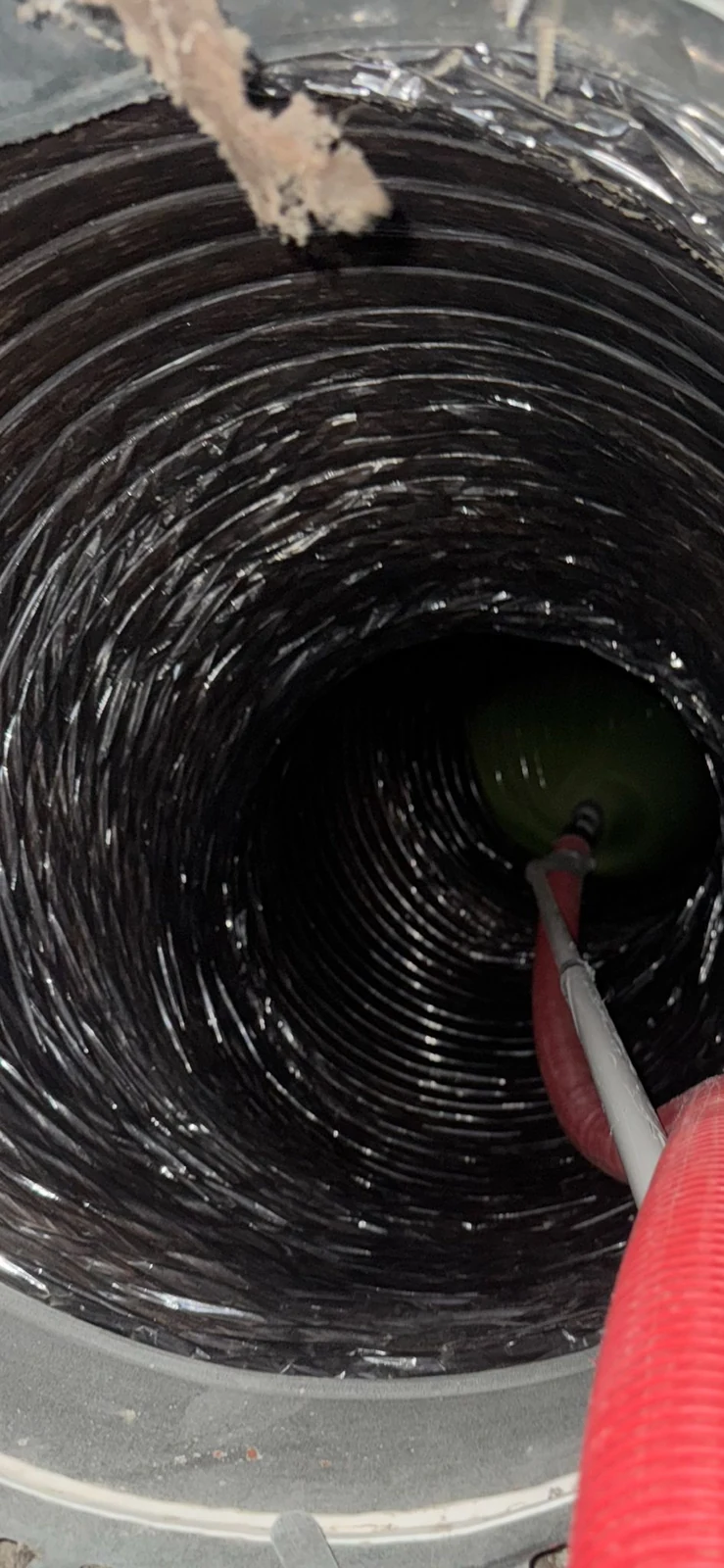
How do you know cleaning part of the system is enough?
The camera decides, not a hunch. We scope the whole system first; if debris is concentrated in the returns or specific branches, we clean those and document the rest as verified clean.
Why are return ducts dirtier than supply ducts?
Because they run upstream of the filter. Returns pull raw room air — dust, pet hair, fibers, pollen tracked in on shoes — straight into the ductwork before anything filters it.
04Book in Houston
Three fields, and a person calls you back.
Tell us the ZIP and we will tell you what your system likely needs — including, sometimes, that it needs nothing yet. Nothing is charged until you have approved a written quote.
05Questions
Asked in Houston, answered straight.
How do you know cleaning part of the system is enough?
The camera decides, not a hunch. We scope the whole system first; if debris is concentrated in the returns or specific branches, we clean those and document the rest as verified clean. If footage shows buildup everywhere, we'll say a full cleaning is the honest recommendation — with the photos to prove it.
Why are return ducts dirtier than supply ducts?
Because they run upstream of the filter. Returns pull raw room air — dust, pet hair, fibers, pollen tracked in on shoes — straight into the ductwork before anything filters it. Supplies only see air the filter has already scrubbed. That asymmetry is why return-side cleaning is often the smartest partial job.
It stays humid here nine months a year. What does that actually do to ductwork?
Long Gulf Coast dew points mean latent load dominates. An oversized system cools fast, shuts off and never dehumidifies, so the coil and supply boots stay damp between cycles. That, not dirt, is the usual root of a musty Houston house, and cleaning without correcting runtime only resets the clock.
Our house took on water in a storm. Can the ducts just be cleaned out?
If floodwater reached the ductwork or the air handler, cleaning is not the correct answer. Porous liners and insulation that have been submerged should be replaced, not treated. We will tell you that even though it is the more expensive recommendation, because the cheaper one does not hold up in this climate.
I'm on the fifteenth floor of an apartment building. Is this even my system?
Largely not, and that is worth knowing before you pay for anything. Most Houston housing units are not detached houses, and in a tower your air handler is a closet unit with very short runs. Filter fit, condensate drainage and return-side leakage are the parts you can actually influence.
Supply & Return Duct Cleaning nearby
Everything we do in HoustonLast reviewed: