Duct Leakage: The Loss You Pay For Twice
Air escaping into an attic is air you paid to condition. The air replacing it is attic air, and it brings the attic's dust with it. Why sealing usually beats cleaning.
Duct leakage is the least visible and most expensive defect in a typical residential system, and it is the reason we so often recommend sealing before cleaning. A leaky duct does not just lose air — it pulls unconditioned air in to replace what it lost, which is where a surprising amount of household dust originates.
01Where systems actually leak
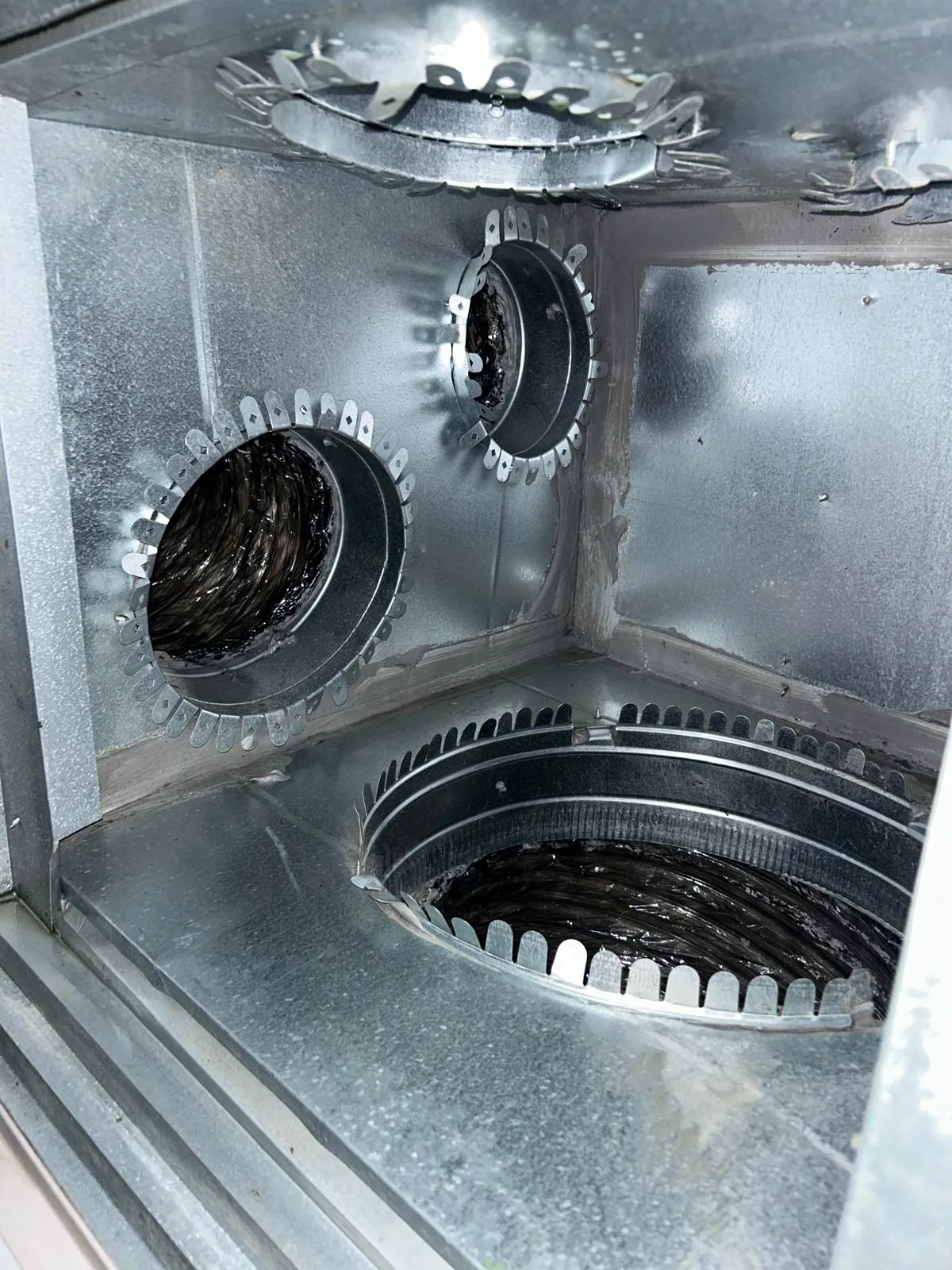
Not evenly. The concentrations are at the boots where duct meets the ceiling or floor opening, at the plenum takeoffs, at longitudinal seams in poorly assembled runs, and at flex-to-metal connections that were taped rather than mastic-sealed.
Boots are the most consistently unsealed joint in residential construction and they sit directly against the attic or crawlspace — which makes them the worst possible place to leak.
02Why you pay for it twice
First, the conditioned air you lose into an attic is energy you bought and did not use. Second, a system that is losing supply air has to draw replacement air from somewhere, and on the return side that means pulling from the attic, the crawlspace or the wall cavities.
That second half is the one people do not expect. It means your air handler is actively importing attic air — and its dust, its fibreglass fragments, its temperature and its humidity — into your living space, continuously, whenever the system runs.
03Which is why sealing often beats cleaning
If your ducts keep getting dirty, the useful question is where the dirt is coming from. Cleaning a system that is drawing attic air resets it to a condition it will leave again. Sealing changes the mechanism.
This is also the honest reason a cleaning sometimes 'does not last'. It was not a bad cleaning. It was a cleaning applied to a supply problem.
04Two ways to seal, and when each is right
Mastic and mesh at every accessible joint is the durable, cheaper option and it is what we recommend first on an attic system with open runs. Its limit is physical: it only seals what can be reached.
Aerosol sealing works from inside the duct and finds leaks behind drywall and buried in insulation that nobody can reach. It costs more, and it is measured — the system is pressure-tested before and after, so you get a number rather than an assurance. Where leakage is diffuse across inaccessible runs, it is the only real option.
05What to ask for
Ask for the pre- and post-seal numbers. Sealing is one of the few things in this trade that is genuinely measurable, and a company that will not measure it is asking you to take the result on faith.
Ask specifically about the boots, too. If the quote does not mention them, the most consistently leaky joints in your house are not in the scope.
If your registers keep collecting dust, look for leakage before booking another cleaning. Sealing addresses why the dust is arriving, it is measurable, and on most systems it is the better first purchase.
Every recommendation here starts from one place: a graded, photographed duct camera inspection — and when it's warranted, a duct sealing (aerosol) done to one standard, with a paper trail you keep.
The Prime Air Duct Experts Team
This article was written and reviewed by the CSIA-certified crew at Prime Air Duct Experts. Every recommendation reflects NFPA 211 and CSIA trade standards and the same documented, photographed approach we hold every job to.
Talk to our team